
Wayne Rubber
Engineering
Resources & Blog
Technical guides, compound selection references, and engineering deep-dives written for OEM designers, maintenance engineers, and procurement teams specifying rubber components.
Showing all posts
Featured
Technical Reference
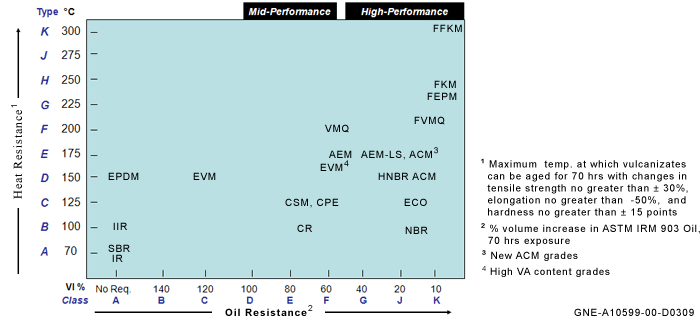
How to Read an ASTM D2000 Rubber Compound Designation
The complete engineer’s guide to the ASTM D2000 line callout system: what each position means, how to construct one from scratch, which suffixes add value vs. cost, and what Type/Class tells you about the polymer that will actually be supplied.
Technical Reference
O-Ring Extrusion Failure: Causes, Prevention & Gland Design
Clearance gap limits by pressure and hardness, the spiral failure mechanism, backup ring selection, and forensic identification of five distinct damage patterns.
Industry Application
Rubber Seals for Data Center Liquid Cooling
Direct liquid cooling vs. immersion cooling: why the two architectures require incompatible elastomers, and compound selection for every sealing zone in each system.
Industry Application
Rubber Seals for EV Battery Packs
Four sealing zones, four compound requirements: pack enclosure gaskets, coolant loop seals, thermal runaway vent valve diaphragms, and cell-level electrode seals.
Industry Application
Rubber Seals and Gaskets for Drones and UAVs
Weight-performance tradeoffs, enclosure IP sealing, motor housing compounds, EMI shielding gaskets, vibration isolation, and MIL-spec requirements for defense UAV programs.
Industry Application
Rubber Seals for Hydrogen Fuel Cells and Electrolyzers
PEM vs. alkaline sealing chemistry, catalyst contamination avoidance, MEA gasket compound selection, and high-pressure electrolyzer requirements to 350 bar.
Industry Application
Rubber Seals for Semiconductor Fabs and Cleanrooms
The three-tier compound hierarchy for fabs, FFKM grade selection by process chamber, plasma vs. UHV vs. EUV grades, and the outgassing constraints no competitor explains.
Industry Application
Rubber Seals for Offshore Wind Turbines
Six simultaneous degradation mechanisms, nacelle gaskets, gearbox shaft seals, pitch bearing dual-compound requirements, blade root seals, and PAO gear oil compatibility.
Industry Application
Rubber Seals for Industrial Robots and Cobots
Harmonic drive grease compatibility, joint seal friction and haptic sensing, food-grade cobot FDA compliance, cleanroom cobot siloxane avoidance, and vacuum cup selection.
Industry Application
Rubber Seals for LNG Infrastructure
The LNG temperature gradient as a compound selection problem: cryogenic zone limits, the transition zone challenge, regasification EPDM applications, and explosive decompression resistance.
Industry Application
Rubber Seals for Surgical Robots and Minimally Invasive Devices
Trocar CO2 insufflation sealing, instrument wrist seal friction vs. haptic sensing, sterilization compatibility matrix, USP Class VI vs. ISO 10993, and single-use vs. reusable strategy.
Industry Application
Rubber in Sports Products
Natural rubber in balls and yoga mats, butyl bladders for air retention, EPDM for outdoor tracks, the PFAS shift in artificial turf, and why bicycle tires still use natural rubber.
Industry Application
Rubber in Pet Products
Shore A ranges by dog size for dental safety, natural rubber vs. silicone for chew toys vs. lick mats, FDA 21 CFR 177.2600 compliance, and the pigmented compound heavy metal risk.
Material Selection
Elastomer Selection for Food Processing & Pharma Equipment
FDA, USP Class VI, NSF-51, and 3-A standards explained. CIP and SIP chemistry impact on compound selection. Application matrix by industry segment.
Technical Reference
What Is Compression Set? Why It Matters for Seal Design
ASTM D395 Method B formula, compound comparison data, and the three failure modes compression set drives in static sealing applications.
Technical Reference
Shore A Durometer and Rubber Seal Performance
How hardness specification affects sealing force, compression set, and extrusion resistance. When to deviate from the 70 Shore A default and why.
Technical Reference
Rubber Gasket Design Guidelines for Engineers
Compression targets, thickness selection, bolt pattern design, surface finish requirements, and tolerance callouts for custom rubber gaskets.
Material Selection
EPDM vs. Nitrile vs. FKM: Gasket Material Selection Guide
Head-to-head comparison of the three most specified gasket elastomers. Fluid compatibility, temperature limits, failure modes, and specification guidance.
Manufacturing
Quality Control in Rubber Manufacturing
Inspection protocols, physical property testing, dimensional verification, and documentation standards for rubber molded components.
Industry & Regulation
The Future of Fluoroelastomers: Navigating the PFAS Challenge
How EPA PFAS regulations affect FKM fluoroelastomer specification, what alternatives exist, and how Wayne Rubber is navigating the changing landscape.
Manufacturing
Rubber Extrusion Manufacturing: An Overview
Process steps, die design, compound requirements, and industry applications for extruded rubber profiles, tubing, and weatherstrip.
Technical Reference
Important Properties for a Rubber Dynamic Seal
Friction, wear resistance, compression set, and surface finish requirements that distinguish dynamic seal design from static sealing applications.
Manufacturing
What Is Rubber Molding?
Compression, transfer, and injection molding compared — process steps, typical applications, tooling considerations, and how to choose between them.
Manufacturing
Rubber to Metal Bonding Methods
Adhesive bonding, mechanical retention, and insert molding compared. Surface preparation, Chemlok primer systems, and bond failure prevention.
Industry & Regulation
Where Does Natural Rubber Come From?
Hevea brasiliensis cultivation, latex harvesting, and the global natural rubber supply chain from tropical plantation to manufactured rubber compound.
Technical Reference
Physical Properties of Rubber: What Engineers Need to Know
Durometer, tensile strength, elongation, compression set, resilience, tear strength, and abrasion resistance — what each property measures and why it matters.
Industry & Regulation
Sustainability in the Rubber Industry
Environmental considerations in rubber manufacturing: renewable feedstocks, recycling challenges, energy use in vulcanization, and the industry’s sustainability trajectory.