
AEM Rubber
Ethylene Acrylic Elastomer | ASTM D1418: AEM
AEM occupies a specific and structurally unique niche in the elastomer landscape. Its polymer architecture combines a saturated backbone (like EPDM, giving it ozone resistance and heat stability) with polar acrylic side groups (like nitrile rubber, giving it oil resistance). No single standard elastomer provides both properties simultaneously. AEM is the compound when an underhood automotive seal must resist hot engine oil and oil additive packages at temperatures above NBR’s limit, while also surviving outdoor exposure and ozone attack that would degrade an unshielded NBR seal.
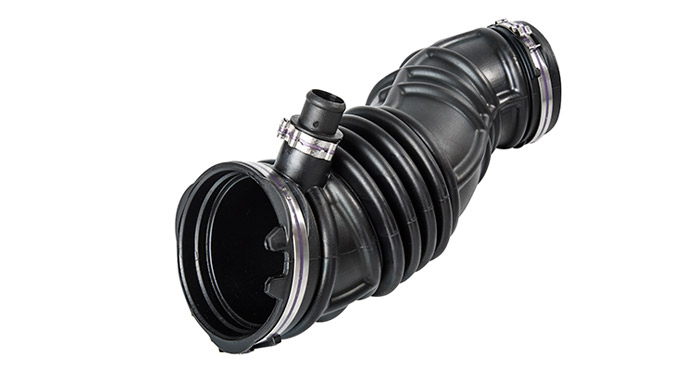
Wayne Rubber manufactures custom AEM seals, gaskets, o-rings, hoses, and molded components in Wixom, Michigan. AEM is a specialty material; it is not a general-purpose substitute for NBR or EPDM, and it is not cheap. It is the correct specification for a defined set of demanding automotive and industrial applications where its particular combination of properties is genuinely required.
The Structural Achievement: Saturated Backbone with Polar Side Groups
The fundamental design challenge in elastomer chemistry for underhood automotive applications is that ozone resistance and oil resistance tend to be mutually exclusive in standard polymers. Ozone resistance requires a saturated backbone (no double bonds susceptible to ozone attack). Oil resistance requires polarity in the polymer chain (charged groups that repel non-polar hydrocarbon molecules). EPDM achieves the saturated backbone but has non-polar methyl groups and no oil resistance. Nitrile rubber achieves polarity through ACN groups but retains double bonds in the butadiene backbone and degrades in ozone.
AEM solves this by building both properties into different parts of the polymer structure. The backbone is constructed primarily from ethylene segments, which are fully saturated (no double bonds), providing resistance to ozone and oxidative degradation. The side groups are acrylic esters (methyl acrylate or ethyl acrylate), which are polar; their ester groups provide the chemical incompatibility with non-polar petroleum hydrocarbons that translates to oil resistance. A small amount of carboxylic acid-containing cure-site monomer is incorporated to provide crosslinking sites for amine-based cure systems.
The result is that AEM has useful ozone resistance (outdoor service without protective coatings for years) alongside useful oil resistance, at a combined performance level that neither EPDM nor NBR alone can provide in a single compound. This structural achievement is why AEM exists as a distinct material family rather than as a formulation variant of an existing polymer.
The ratio of ethylene to acrylate in the copolymer controls the balance between the two properties. Higher ethylene content improves low-temperature flexibility (ethylene segments lower the glass transition temperature) and heat stability, but reduces oil resistance. Higher acrylate content improves oil resistance and heat resistance but reduces low-temperature flexibility. Standard AEM compounds balance these at a composition that targets the underhood automotive envelope of -40°F to 375°F continuous service with acceptable oil resistance in engine and transmission fluid contact applications.
AEM vs. NBR, ACM, EPDM, and HNBR
AEM is most clearly understood by its position relative to the four elastomers it most often competes with or replaces in automotive underhood applications. Each competitor has at least one critical gap that AEM fills.
AEM Chemical Resistance Summary
| Fluid / Environment | Resistance | Notes |
|---|---|---|
| Hot Engine Oil (above 300°F) | Excellent | AEM’s defining advantage over NBR and HNBR. Modern engine oils contain aggressive additive packages (sulfated ash compounds, detergents, friction modifiers) that attack NBR at elevated temperatures. AEM resists both the base oil and the additive package at continuous temperatures that cause NBR to harden and crack. The standard specification for cylinder head cover gaskets, crankshaft seals, and valve cover gaskets in high-performance and turbocharged engines where oil temperatures routinely exceed 250°F. |
| Transmission and ATF Fluids | Excellent | Excellent resistance to automatic transmission fluids, synthetic gear oils, and power steering fluids. Transmission seals and differential seals in modern vehicles with high-efficiency transmissions running hotter than older designs are a primary AEM application domain. AEM maintains sealing integrity in contact with synthetic and semi-synthetic ATF grades that cause accelerated degradation in NBR compounds. |
| Ozone and UV | Excellent | The saturated ethylene backbone provides EPDM-level ozone resistance. AEM seals exposed to underhood ozone concentrations and UV from engine bay access openings maintain their surface integrity for the service life of the vehicle. This is the property that distinguishes AEM from NBR and ACM, which both degrade rapidly in ozone-exposed underhood locations. |
| Biodiesel (B20 to B100) | Excellent | AEM has excellent resistance to biodiesel fuel blends including high-content biodiesel (B100) that causes significant swelling in standard NBR and degrades ACM. As fleet operators and agricultural equipment manufacturers transition to high-blend biofuels, AEM is increasingly specified for fuel system seals where standard NBR performance has become inadequate. This biodiesel resistance advantage over NBR is one of AEM’s most practically important current growth areas. |
| Water and Glycol (to 212°F) | Good | Good resistance to water and ethylene glycol-based engine coolants at temperatures up to approximately 212°F. Above this temperature, water resistance decreases progressively. AEM is adequate for coolant-adjacent sealing where brief contact occurs but is not the correct specification for continuous hot coolant immersion; EPDM remains the standard for coolant system gaskets. |
| Oxygenated Fuels (gasoline/ethanol blends) | Good | Good resistance to ethanol-blended gasoline (E10, E15, E85), maintaining better integrity than standard NBR in high-ethanol fuel blends. AEM is specified for fuel system seals in flex-fuel vehicles operating on high-ethanol content fuel at elevated underhood temperatures where NBR’s marginal ethanol resistance becomes a reliability issue. |
| Petroleum Fuels (standard gasoline, diesel) | Moderate | AEM has moderate resistance to standard petroleum fuels, adequate for fuel vapor and splash exposure but not for continuous fuel immersion. AEM is not a fuel-immersion compound in the same class as high-ACN NBR or FKM. For fuel tank and fuel line seals in continuous fuel contact, NBR or FKM remains the correct specification. AEM’s fuel resistance makes it adequate for underhood environments where fuel splash and vapor are present alongside hot oil. |
| Ketones and Esters | Poor | AEM is attacked by ketones and esters. The acrylic ester side groups that provide oil resistance are reactive toward ketone and ester solvents. Not suitable for applications involving these fluid types. Avoid ketone-based cleaning solvents during assembly and maintenance of AEM-sealed components. |
| Aromatic Solvents (toluene, xylene) | Poor | Poor resistance to aromatic hydrocarbons. Not suitable for aromatic solvent contact. FKM is required for aromatic solvent service. |
| Concentrated Acids and Strong Alkalis | Poor | AEM does not provide useful resistance to concentrated mineral acids or strong alkali solutions. For aggressive chemical service, EPDM (aqueous alkaline), FKM (concentrated acid), or FFKM (extreme chemical resistance) should be specified. |
AEM vs. HNBR: The Other Upgrade from NBR
Both AEM and HNBR are used as upgrades from standard NBR when the application exceeds NBR’s temperature limit or ozone resistance. The correct choice between them depends on the specific failure mode being addressed and the cost sensitivity of the application.
HNBR improves on NBR by saturating the butadiene backbone, adding ozone resistance and increasing the temperature limit to 300°F continuous. HNBR also adds H2S and amine resistance important for oil and gas applications. HNBR’s tensile strength and mechanical properties are excellent, and it is available in a wide ACN content range to tune oil resistance and low-temperature performance.
AEM improves on NBR by a fundamentally different structural route: building polarity into side groups on a saturated backbone rather than saturating a nitrile copolymer. AEM’s maximum temperature (375°F) is higher than HNBR’s (300°F). AEM’s biodiesel resistance is better. AEM’s vibration damping characteristics over a wide temperature range are superior to HNBR. AEM is specifically optimized for underhood automotive environments with aggressive oil additive packages.
HNBR’s advantages over AEM include its broader ACN content range enabling precise low-temperature tuning, its better mechanical properties (tensile strength, tear resistance), and its H2S and amine resistance that makes it the dominant compound for oil and gas downhole applications. HNBR is more widely available and somewhat lower in cost than AEM.
The decision between them: for oil and gas downhole or industrial hydraulic applications, HNBR is typically the correct choice. For automotive underhood applications, specifically the combination of hot engine oil, aggressive ATF additives, ozone, biodiesel, and the low-temperature cold-start requirement, AEM is the more precisely targeted compound and often the OEM specification material. When HNBR and AEM both meet the temperature and oil requirements, HNBR is usually lower-cost and more readily available.
AEM in Halogen-Free Flame-Retardant Cable Applications
AEM’s fully halogen-free polymer structure makes it a technically valuable compound for cable jacketing and insulation applications where flame retardancy is required but halogenated compounds (PVC, neoprene) are excluded by specification. Halogenated flame retardants and polymers release toxic hydrogen halide gases when burned, a critical concern in transportation, tunnel, and building applications where fire survival time matters.
AEM can be formulated with halogen-free flame retardants (typically metal hydroxide-based systems such as ATH (aluminum trihydrate) and MDH (magnesium dihydroxide) to achieve V-0 or better flame ratings per UL 94 and IEC 60332 without halogens. The compound retains AEM’s inherent flexibility at low temperatures, ozone resistance, and heat aging stability, properties that are difficult to achieve simultaneously in halogen-free cable compounds based on EPDM or polyolefin systems that lack AEM’s thermal stability and dynamic properties.
This application is important in automotive wire harness insulation (JASO and LV 112 specifications for automotive low-voltage wire), mass transit (railway and subway cable specifications requiring halogen-free, flame-retardant, and low-smoke compounds), and industrial equipment in confined spaces where fire codes require halogen-free materials.
AEM Rubber Applications
AEM Rubber Products from Wayne Rubber
Wayne Rubber manufactures custom AEM components for demanding automotive and industrial applications. Specify the oil type and temperature, ozone exposure, low-temperature operating requirement, and biodiesel content if applicable when requesting a quote.
Request Custom AEM Parts from Wayne Rubber
Provide your part drawing, oil type and temperature, ozone exposure condition, low-temperature requirement, and biodiesel content if applicable. Wayne Rubber will confirm AEM is the correct compound and provide a quote.