
Custom Rubber Hose
Catalog rubber hose covers straight lengths in common compounds and standard inside diameters. It works for the majority of fluid transfer applications where the hose runs straight between two ports at close proximity. What catalog hose cannot provide is a complex routed geometry: a hose that must follow a specific path around other components and arrive at a specific angle at each end, or a compound specification outside the catalog: a peroxide-cured EPDM for steam service, an NBR grade with a specific durometer for a tight bend radius, or a silicone grade with USP Class VI certification for pharmaceutical process fluid contact. For these requirements, the hose must be manufactured to specification rather than selected from stock.
Wayne Rubber manufactures custom rubber hose for industrial OEM, automotive, marine, agricultural, and process equipment applications in Wixom, Michigan. Extruded straight hose, mandrel-formed hose in complex geometries, and short-run molded hose in EPDM, NBR, neoprene, silicone, and natural rubber with unreinforced, fabric-braid, and wire-spiral reinforcement construction.
Three Rubber Hose Manufacturing Processes
The manufacturing process determines the hose geometry, the dimensional tolerances achievable, and the minimum production quantity that is economical. Selecting the correct process at the design stage avoids costly tooling changes or process switches when a catalog hose geometry does not fit the routed application.
Rubber compound forced through a die that defines the hose cross-section, then vulcanized in a continuous line and cut to length. Produces hose of any length in a consistent circular cross-section at the lowest cost per unit length of the three processes. Best for: straight runs between two ports; hose supplied in bulk roll or coil form for field cutting; standard ID/OD with tight wall thickness control; high-volume programs where the hose path is straight or accommodates field bending. Limitations: extruded hose cannot hold complex three-dimensional bends without a mandrel cure step; extruded hose that must follow a specific path will spring back toward straight when released from the clamps, potentially pulling off fittings or introducing stress at the fitting interface. For any hose that must hold a specific routed geometry without clamps, mandrel forming is required.
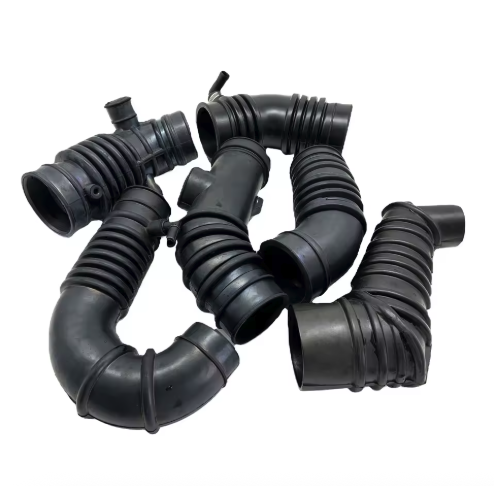
Extruded hose placed over a mandrel shaped to match the required hose path geometry, then vulcanized in that shape. The mandrel cure sets the hose into the required bends, elbows, and offsets permanently, so the hose holds its routed geometry without clamping force. Best for: complex hose geometries with specific bend radii, multiple elbows, and compound curves; coolant hoses, heater hoses, air intake hoses, and any hose that must follow a defined path between fixed ports in an engine, chassis, or equipment layout. Critical parameter: the mandrel must match the exact hose path including all bend radii and axial rotations; mandrel drawings are derived from a path layout on the actual equipment or from a CAD model. Wayne Rubber can produce mandrel geometry from equipment samples, 3D scans, or CAD path files. Production economics: mandrel cost is modest relative to mold tooling; mandrel-formed hose is the standard method for low-to-medium volume custom hose programs.
Uncured rubber placed in a closed cavity mold that defines both the inner bore and the outer profile of the hose, then cured under heat and pressure. Produces hoses with the tightest dimensional tolerances of the three methods and can incorporate features that neither extrusion nor mandrel forming can produce: flared or flanged ends, molded-in connectors, varying wall thickness along the hose length, and complex end geometries that mate to specific fittings. Best for: short, complex hose assemblies with precision end geometry; hose-to-fitting integration where the rubber must seal against a specific fitting face profile; hoses requiring consistent wall thickness at tight-radius bends where mandrel-formed hose can thin the wall on the outside of the bend; medical and food-processing hose assemblies requiring cleanable surfaces on both the bore and exterior. Limitation: mold tooling cost is higher than mandrel cost; economic for high-volume programs or applications where mandrel forming cannot achieve the required end geometry.
Hose Reinforcement Construction and Pressure Rating
Reinforcement determines the hose’s pressure rating, flexibility, and resistance to vacuum collapse. The correct reinforcement construction matches the working pressure, vacuum level, and minimum bend radius of the application.
Solid rubber wall without any embedded reinforcement layer. Maximum flexibility; lowest pressure rating; susceptible to vacuum collapse at higher vacuum levels. Correct for low-pressure fluid transfer (under 50 PSI), low-vacuum applications, and any application where flexibility at small bend radius is the primary requirement. Standard for peristaltic pump tube, drain hose, and atmospheric-pressure fluid conveyance. The thicker the wall relative to the bore, the higher the vacuum resistance without reinforcement.
One or more layers of textile fiber (polyester, nylon, or aramid) braided over the rubber tube, then covered by an outer rubber jacket. Each braid layer adds approximately 50-150 PSI to the working pressure rating depending on fiber and braid angle. Standard construction for automotive coolant hose (single braid, 50-80 PSI), industrial water and steam hose (two-braid, 150-200 PSI), and vacuum hose (single braid prevents collapse). Fabric braid maintains significantly more flexibility than wire spiral and is correct for hoses that must flex during installation or accommodate thermal expansion movement.
Steel wire wound in a spiral pattern over the rubber tube, then covered by an outer jacket. Wire spiral provides the highest pressure ratings (400 PSI and above for multiple wire layers) and maximum resistance to vacuum collapse, but significantly reduces hose flexibility and increases minimum bend radius. Correct for hydraulic hose operating above 200 PSI, vacuum hose on systems with high vacuum levels where fabric braid would collapse, and suction hose where the bore must remain round under negative pressure. Not suitable for applications requiring tight bend radii or frequent flexing.
Rubber Hose Compound Selection Guide
Hose compound selection follows the same logic as any fluid-contact rubber component: the rubber must be chemically compatible with the fluid being conveyed, must maintain its elastic properties over the full temperature range of the fluid, and must resist any external environmental exposure (UV, ozone, abrasion, oil splash) at the hose exterior. Hose applications add one constraint that static sealing applications do not: the compound must also maintain its burst pressure and vacuum resistance over repeated thermal and pressure cycling, which places demands on compression set and fatigue resistance that are less critical in static gaskets.
EPDM is the standard compound for coolant hose (water and glycol-based coolants), steam hose, and outdoor-exposed fluid transfer hose. It cannot be used with petroleum oils or fuels. NBR is the standard compound for petroleum oil, fuel, and hydraulic fluid hose. It degrades rapidly in outdoor UV and ozone exposure without a protective jacket. Neoprene provides the best balance of moderate oil, UV, and ozone resistance for hose in industrial environments where the fluid is not definitively petroleum-free. Silicone is required for high-temperature applications above EPDM’s 300°F limit, for food and pharmaceutical fluid contact where FDA or USP compliance is required, and for vacuum lines requiring maximum flexibility at low temperature.
AEM (polyacrylate) is the correct compound for underhood automotive hose with simultaneous hot oil exposure and ozone resistance requirements that exceed NBR’s outdoor durability. Modern engine bay air intake hoses on turbocharged engines with positive crankcase ventilation (PCV) systems experience a combination of hot oil vapor contact at the bore and UV/ozone exposure on the exterior that NBR cannot sustain. AEM handles both simultaneously and is increasingly specified for turbo inlet hoses and crankcase ventilation hose on emissions-compliant engines.
The cure system matters for EPDM hose in steam and hot water service, just as it does for EPDM sheet. Sulfur-cured EPDM hose is adequate for coolant service below 250°F and general water service. Peroxide-cured EPDM hose has better compression set resistance, better resistance to steam above 250°F, and lower extractable content for food and potable water contact applications. Wayne Rubber produces peroxide-cured EPDM hose for steam jacketed equipment, food processing fluid transfer, and potable water system connections where the sulfur-cured catalog grade does not meet the compound specification or regulatory requirement.
| Compound | Hose Applications | Key Properties | Avoid When |
|---|---|---|---|
| EPDM | Engine coolant hose (water and glycol); radiator and heater hose; steam hose (peroxide-cured grade); outdoor-exposed fluid transfer hose; compressed air hose; potable water and food-service fluid lines (FDA-grade peroxide-cured); HVAC chilled water and hot water hose | Best outdoor UV, ozone, and steam resistance for standard coolant and water hose; peroxide-cured grade for steam above 250°F and food/water regulatory compliance; SAE J20 grades for automotive coolant hose programs; widest use in industrial water system hose | Petroleum oil, hydraulic fluid, or fuel in the hose bore; oil-splash environment on hose exterior without a protective jacket (NBR or neoprene outer jacket required); continuous service above 300°F (silicone required) |
| NBR | Hydraulic hose for petroleum-based fluids; fuel filler and vent hose; engine oil drain and bypass hose; machine tool coolant hose with oil-based cutting fluid; fuel line hose on equipment below 250°F service temperature | Standard petroleum oil and fuel resistance for hydraulic and fuel system hose; good compression set resistance for hose ends under clamp load; cost-effective for high-volume petroleum fluid hose programs | Outdoor UV and ozone exposure without a protective outer layer; steam and hot water service; fluid temperatures above 250°F sustained service (HNBR required at elevated temperatures); ketone and ester solvents |
| Neoprene | Industrial fluid transfer hose in environments with moderate oil contact; refrigeration suction and discharge hose; outdoor industrial equipment fluid hose with combined UV and oil splash exposure; marine engine coolant and fuel hose where balanced media resistance is required | Balanced moderate oil, UV, and ozone resistance for industrial hose in mixed-environment applications; good flame resistance for hose on equipment near ignition sources; standard marine engine hose compound for general fluid service | Sustained petroleum hydraulic fluid at high temperature (NBR or HNBR required); aggressive chemical or solvent service; food and pharmaceutical fluid contact without FDA grade specification |
| Silicone | High-temperature coolant hose above EPDM’s service limit; turbocharger boost hose and intercooler piping; air intake hose on high-output engines; pharmaceutical and food process fluid hose (USP Class VI or FDA grade); medical device fluid transfer tubing; vacuum hose requiring maximum low-temperature flexibility | Widest temperature service range for hose above 300°F; USP Class VI and FDA grades for pharmaceutical and food contact; excellent low-temperature flexibility for vacuum hose operated in cold environments; non-reactive with most process fluids for pharmaceutical service | Petroleum oil or fuel in the bore (silicone swells in oil contact); high-pressure hydraulic applications without wire reinforcement (silicone’s lower tensile strength requires heavier reinforcement than EPDM or NBR at equivalent pressure rating); cost-sensitive general industrial hose where EPDM or neoprene is adequate |
| AEM | Underhood turbocharger inlet and PCV hose with combined hot oil vapor bore contact and external ozone exposure; modern diesel engine air management hose on equipment with ozone resistance requirements; hose on engines running biodiesel blends where NBR’s fuel resistance is required alongside better ozone resistance than NBR provides | Hot oil vapor resistance at the bore combined with ozone resistance on the exterior; the correct upgrade from NBR for hose on high-output turbocharged engines where underhood temperatures and external ozone exposure simultaneously exhaust NBR; better aging resistance than NBR in modern hot underhood environments | High-pressure hydraulic hose with concentrated aromatic solvent contact; applications where EPDM’s temperature and UV range is sufficient and the AEM cost premium is not justified; cryogenic or very low-temperature applications where AEM stiffens below its glass transition |
| Natural Rubber | High-resilience peristaltic pump tubing where the hose wall must flex millions of cycles without fatigue failure; flexible coupling hose between vibrating equipment and rigid piping; air and water hose in clean indoor environments where UV and oil exposure is absent | Best fatigue life under repeated wall compression for peristaltic pump tubing; highest resilience for flexible coupling hose on vibrating equipment; lowest compression set for hose that must spring back fully after each peristaltic compression cycle | Outdoor UV and ozone without a protective jacket; petroleum oil or fuel contact; elevated temperature service above 200°F; chemical process environments |
Custom Rubber Hose Applications by Industry
- Radiator and heater hose in mandrel-formed EPDM
- Turbocharger boost and intercooler silicone hose
- Crankcase ventilation hose in AEM or NBR
- Power steering return hose in NBR
- Transmission cooler line hose in NBR
- Air intake and mass airflow sensor hose in EPDM or AEM
- Steam jacketed equipment hose in peroxide-cured EPDM
- Chemical process fluid transfer in compound-specified hose
- Compressed air hose in EPDM for clean dry air systems
- Hydraulic return line hose in fabric-braid NBR
- Machine tool coolant hose in oil-resistant compounds
- Peristaltic pump tubing in natural rubber or silicone
- Tractor and combine coolant hose in EPDM
- Hydraulic system hose in wire-spiral NBR
- Air intake hose on diesel engines in AEM or EPDM
- Fuel filler and vent hose in NBR
- Chemical spray system hose in chemically compatible compounds
- Irrigation and water transfer hose in EPDM
- Engine cooling raw water hose in EPDM
- Bilge and exhaust cooling hose in neoprene
- Fuel system hose in NBR or FKM
- Steering system hydraulic hose
- Shore power cable and hose assemblies
- Sanitation system hose in ozone-resistant compounds
- FDA-grade EPDM or silicone product transfer hose
- USP Class VI silicone hose for pharmaceutical fluid contact
- CIP (clean-in-place) system hose in FDA compounds
- Peristaltic pump tubing for aseptic filling systems
- Jacketed hose for temperature-controlled ingredient transfer
- NSF-61 potable water compliant hose for water systems
- Chilled water and hot water flexible connector hose
- Refrigeration suction and discharge hose in neoprene
- Air handling unit condensate drain hose
- Pump isolation flexible hose connectors
- Thermal expansion loop hose in EPDM
- Fan coil unit water connection flexible hose
Also from Wayne Rubber
Request Custom Rubber Hose from Wayne Rubber
Provide the fluid being conveyed, the operating temperature and pressure or vacuum level, the hose path geometry (straight, formed, or molded), any regulatory requirements (FDA, NSF, SAE, MIL-SPEC), and the quantity. Wayne Rubber will specify the compound, reinforcement, and process and provide a quote.