
Rubber Grommets
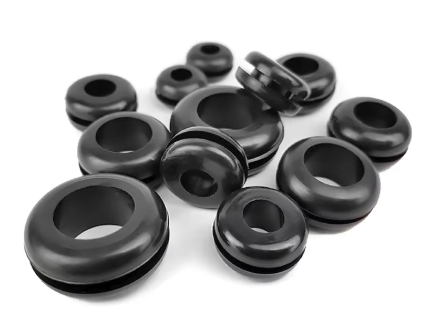
Wayne Rubber manufactures custom molded rubber grommets for wire and cable protection, panel edge sealing, and vibration isolation in electrical enclosures, automotive wiring harnesses, industrial control panels, and aerospace equipment. Available in standard round, oval, multi-hole, blind, horseshoe, and split configurations, with open, slit-membrane, or star-membrane ID options for sealed cable pass-throughs.
Grommets solve three distinct engineering problems, each with different dimensional and material requirements. The sections below cover all three so you can identify the right design for your application before requesting a quote.
Three Purposes, Three Different Design Priorities
Rubber grommets are specified for three distinct engineering purposes, each with different design requirements for geometry, durometer, and material. Identifying which problem the grommet is solving determines every subsequent specification decision.
The grommet lines a drilled or punched hole in a metal panel to prevent the sharp cut edge from abrading, cutting, or wearing through wires, cables, hoses, or tubing passing through it. The key design parameters are the panel thickness (controls the groove width), the panel hole diameter (controls the OD), and the ID required for the cable or tube. Durometer is typically 50 to 70 Shore A: soft enough to install by snap-fit, firm enough to retain its groove engagement. No sealing is required; the ID hole is open.
The grommet acts as a flexible mount between a component (motor, sensor, electronic assembly) and a rigid panel, decoupling vibration transmission between the two. The design priority shifts from edge protection geometry to stiffness and fatigue life. Wall thickness, rubber volume, and compound modulus determine the isolation frequency and load rating. Harder compounds (60 to 75 Shore A) give stiffer isolation; softer grades (40 to 55 Shore A) give lower natural frequencies. The grommet typically has a through-bolt passing through the ID rather than a cable.
The grommet forms a weather, dust, or fluid seal around a cable or wire passing through a panel, keeping the interior of an enclosure protected. The ID must seal tightly around the cable diameter. Three ID configurations are available: open (sized snugly to the cable OD), single-slit membrane (a pre-cut slit allows the cable to pass while flexing closed around it), and star-membrane (multiple radial slits accommodate a range of cable diameters while conforming tightly to each). Material must be appropriate for the exterior environment: UV, ozone, fluid splash, or temperature.
Rubber Grommet Types
| Type | Description | Typical Use |
|---|---|---|
| Standard Round | Circular OD with a circumferential groove that snaps into a round panel hole. Open, slit, or star-membrane ID. The most common configuration for single-cable pass-throughs in metal enclosures and electrical boxes. | Single wire or cable protection through round panel holes |
| Multi-Hole | A single grommet body with two or more ID channels, allowing multiple cables or tubes to pass through a single panel opening. Reduces the number of panel holes required and simplifies assembly. | Wire harnesses, multi-cable control panel pass-throughs |
| Oval / Rectangular | Matches oval or rectangular panel cutouts where a round hole is not feasible or where the cable group has an elongated cross-section. Also used to protect oval cable bundles passing through standard oval-punched panel knockouts. | Oval panel cutouts, automotive firewall harness pass-throughs |
| Blind / Plug | A solid-faced grommet with no through-hole. Used to seal unused panel holes. Knockouts stamped in advance for possible future use that need to be closed before the product ships. Often removed and replaced with a cable grommet if the hole is later used. | Sealing unused panel knockouts in enclosures and housings |
| Split / Horseshoe | A grommet with a radial cut from the OD to the ID, allowing it to be installed around an existing cable without threading the cable through the ID. Used when the cable is already routed and cannot be disconnected for grommet installation, or for retrofit situations. | Retrofit installation on in-situ cables, service access panels |
| Extended Neck | A grommet with a longer neck section to accommodate thicker panels or to create a longer protective sleeve around the cable as it exits the panel. The neck prevents chafing along a longer transition from the panel surface to free cable routing. | Thick-panel installations, transition protection in automotive and industrial enclosures |
| Mounting Hole | A compact grommet with a smaller outer flange than standard configurations, for installations where panel space is limited. Often used at higher packing densities in control cabinets where multiple grommets share a row. | High-density control panels, compact electrical enclosures |
| MS-35489 Military | Standard military grommet specification covering round insulation grommets for wire and cable protection. Wayne Rubber manufactures to MS-35489 dimensional requirements in neoprene and other elastomers meeting military material specifications. | Military vehicle wiring, defense electronics, MIL-SPEC assemblies |
Dimensions to Provide for a Quote
A rubber grommet is fully defined by six dimensions plus the panel thickness, the cable or tube OD, and the purpose. Providing all of these up front eliminates back-and-forth and allows Wayne Rubber to quote without assumptions.
The diameter of the drilled or punched hole in the panel that the grommet snaps into. This sets the grommet OD at the groove root. Specify the nominal hole diameter and tolerance; stamped holes vary more than drilled holes.
Controls the groove width and depth of the circumferential snap-fit groove. Grommet groove width must match panel thickness for the grommet to seat flush without rocking. Specify the actual panel material thickness, not the nominal gauge.
The inner diameter that the cable, wire, or tube passes through. For edge protection with an open ID, the ID is slightly larger than the cable OD. For sealing grommets, the ID equals or is slightly smaller than the cable OD so the rubber lip forms a contact seal around the cable.
The outer flange bears against the panel face on both sides after snap-fit installation, retaining the grommet and protecting the panel edge. Flange OD must be large enough to overhang the panel hole with sufficient bearing area. Flange thickness affects installation snap-force and panel coverage.
The outside diameter of whatever passes through the grommet ID. For sealing applications, grommet ID is designed to grip the cable OD under compression. For edge protection, ID clearance is designed so the cable can be routed without deforming the grommet.
Edge protection, vibration isolation, or environmental sealing: each requires a different design approach. Also specify the external environment: UV/ozone exposure, fluid contact, temperature range, and any dielectric requirement. These determine material selection.
Grommet Materials
The most widely used grommet compound for general industrial and automotive applications. Good ozone, UV, and moderate oil resistance. Meets MS-35489 military grommet requirements. The default material for outdoor, automotive, and marine panel grommets.
View CR data →Excellent weather, UV, ozone, and hot water resistance. The correct choice for outdoor electrical enclosures, HVAC equipment grommets, and water-wetted environments where neoprene is adequate but EPDM provides longer service life. Not suitable for petroleum fluid contact.
View EPDM data →Wide temperature range for high-temperature or extreme cold applications. FDA-compliant grades for food processing and medical equipment. Used in oven, furnace, and engine-bay grommets where neoprene and EPDM exceed their temperature limits.
View silicone data →Oil and fuel resistant. Required for grommets in engine bays or industrial enclosures where the grommet exterior contacts petroleum-based fluids. The standard compound for fuel line pass-through grommets in automotive and marine applications.
View NBR data →Used for vibration-isolating grommets where fatigue life under repeated flex is the primary requirement and outdoor UV/ozone exposure is not present. Best fatigue characteristics of any commodity elastomer; not suitable for petroleum or ozone exposure.
View NR data →Chemical and high-temperature resistant grommets for aerospace, chemical plant, and fuel system applications where the grommet contacts aggressive fluids or operates continuously above 250°F. Higher cost; specify only where the environment requires it.
View FKM data →Rubber Grommet Applications
Grommet Manufacturing Capabilities
- Compression Molding: standard process for most grommet geometries and volume ranges
- Transfer Molding: for complex geometries, multi-hole configurations, and insert grommets
- Injection Molding: for high-volume grommets requiring tight dimensional consistency
- MS-35489 Compliance: military-specification grommets in neoprene and compliant compounds
- Open, Slit, and Star-Membrane IDs: all three ID configurations available in any grommet size
- Split Grommets: radially slit for retrofit installation on in-situ cables
- Blind/Plug Grommets: solid-faced for sealing unused panel knockouts
- Custom Geometries: oval, rectangular, extended neck, flanged, and multi-hole configurations
- Durometer Range: 40 to 80 Shore A across all listed elastomer families
- Prototype to Production: development quantities through full production runs
Request a Quote for Custom Rubber Grommets
Provide your panel hole diameter, panel thickness, cable OD, grommet purpose, and environment. Wayne Rubber will recommend the right type, material, and ID configuration.