
Rubber Diaphragms
Wayne Rubber manufactures custom rubber diaphragms for pumps, valves, actuators, pressure regulators, and flow control equipment. Available as flat homogeneous diaphragms, fabric-reinforced diaphragms, and rolling diaphragms across all major elastomer compounds, from prototype quantities through high-volume production.
Diaphragms are precision components. Every application involves a specific pressure range, fluid compatibility requirement, flex cycle count, and dimensional tolerance. Wayne Rubber’s engineering team works with your design requirements to specify the right construction, reinforcement, and compound before tooling is committed.
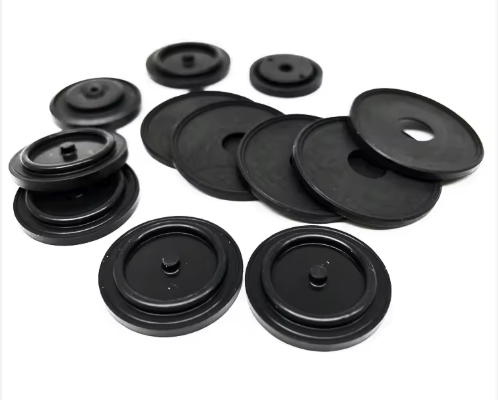
Types of Rubber Diaphragms
The diaphragm construction type determines its pressure capability, flexibility, and service life. Selecting the right type is the first decision in any diaphragm design, and it depends primarily on the pressure range and the number of flex cycles the part must survive.
Produced entirely from rubber with no fabric reinforcement. Used in low-pressure applications where high flexibility and sensitivity to small pressure changes are required. Common in pressure gauges, sensing applications, and low-pressure regulators. More economical than fabric-reinforced construction and easier to produce in complex profiles.
One or more plies of woven fabric embedded within or bonded to the rubber layer. The fabric carries tensile load, allowing a thinner rubber wall to withstand higher pressures without excessive deformation. Fabric options include nylon and polyester for general service, and Nomex (aramid) for elevated temperatures. The standard construction for pump, actuator, and control valve diaphragms.
Designed to roll along the cylinder wall as the piston travels, maintaining consistent effective area and seating force throughout the full stroke. Used in pneumatic cylinders, precision actuators, and applications requiring low friction and long stroke travel. Rolling diaphragms provide frictionless motion and are particularly suited to medical devices and instrumentation where consistent force response is critical.
Molded with one or more convolutions (pleats) in the active area to increase stroke length without stretching the rubber. The convoluted geometry distributes flex stress across a larger surface, significantly extending fatigue life compared to flat diaphragms at equivalent stroke. Common in HVAC actuators, automotive brake boosters, and expansion chambers requiring moderate stroke.
The diaphragm is bonded directly to a metal carrier, insert, or mounting plate during molding. This eliminates separate assembly steps, improves clamping reliability, and prevents edge leakage at the diaphragm perimeter. Common in valve actuators, automotive brake components, and precision control devices where the diaphragm and its housing must function as a single integrated assembly. See our Rubber-to-Metal Bonding page for more detail.
A PTFE (polytetrafluoroethylene) layer is bonded to the process-contact face of the rubber diaphragm, providing chemical inertness against aggressive media while the rubber backing supplies the necessary flexibility and mechanical support. Used in chemical processing, pharmaceutical, and semiconductor applications where the fluid is incompatible with any standard elastomer but a rigid PTFE component cannot flex sufficiently.
How Rubber Diaphragms Function
Pressure Separation
A diaphragm creates a flexible barrier between two chambers, allowing pressure to be transmitted across the barrier by deflecting the membrane without permitting fluid or gas to cross from one side to the other. In a pump, the diaphragm alternately expands and contracts to draw fluid through an inlet valve and expel it through an outlet valve. In an actuator, pressure applied to one face of the diaphragm generates a mechanical force on the connected mechanism.
Because the diaphragm flexes rather than slides, it generates no friction and produces no wear particles. This makes diaphragm-based designs preferable to piston-based designs in applications requiring contamination-free fluid handling, long maintenance intervals, or the ability to pump abrasive or shear-sensitive media.
Fatigue Life and Flex Cycles
The service life of a rubber diaphragm is governed by fatigue from repeated flexing. The key design parameters affecting fatigue life are wall thickness, stroke length, operating pressure, and compound selection. Thinner walls flex more easily but reach fatigue failure sooner under high pressure. Fabric reinforcement allows a thinner rubber wall to carry more pressure load without overstress, extending fatigue life significantly.
Diaphragm compounds are selected not only for chemical compatibility with the process fluid but also for flex fatigue resistance. Natural rubber and EPDM typically offer the best raw flex fatigue performance. For chemically demanding environments, the compound must balance fatigue resistance against the chemical resistance properties required by the application.
Diaphragm Manufacturing Capabilities
- Compression Molding: for flat and moderately complex diaphragm profiles at medium-to-high production volumes
- Transfer Molding: for fabric-reinforced diaphragms and rubber-to-metal bonded assemblies requiring controlled material placement
- Injection Molding: for high-precision profiles requiring tight dimensional repeatability and minimal flash
- Fabric Reinforcement: nylon, polyester, and Nomex fabric options; single and multi-ply constructions available
- Rubber-to-Metal Bonding: diaphragm bonded to steel, aluminum, or brass inserts during the molding process
- PTFE-Faced Diaphragms: PTFE layer bonded to the process face for aggressive chemical service
- RMA A2 Tolerances: molding tolerances compliant with Rubber Manufacturers Association A2 precision standard
- FDA and USP Grades: food-contact and biocompatible compounds available for medical and food processing diaphragms
Diaphragm Applications by Equipment Type
Diaphragms appear across a uniquely wide range of precision equipment. The application determines the required construction type, pressure rating, compound, and flex cycle life.
Diaphragm Materials
Compound selection for a diaphragm involves balancing chemical compatibility with the process fluid against flex fatigue resistance, temperature range, and any regulatory requirements. Wayne Rubber works with a network of rubber compounders to source the right grade for your specific application.
Best general-purpose diaphragm compound for oil, fuel, and hydraulic fluid service. Excellent abrasion resistance and good fatigue life. Standard choice for pneumatic actuators and fuel system diaphragms.
View NBR data →Outstanding flex fatigue resistance and excellent resistance to water, steam, and many polar solvents. The preferred compound for water treatment diaphragms and outdoor weathering service.
View EPDM data →Highest raw flex fatigue performance of any elastomer. Used where maximum diaphragm life under repeated flexing is the primary requirement and chemical exposure is limited to mild, non-petroleum media.
View NR data →Wide temperature range and FDA/USP Class VI compliance for medical devices, food processing equipment, and high-temperature diaphragm applications where NBR or EPDM reach their thermal limits.
View silicone data →Good balance of oil resistance, weathering, and flex fatigue. Used in HVAC actuators, refrigerant handling, and general industrial diaphragm applications where neither NBR nor EPDM is ideal.
View CR data →For chemically aggressive diaphragm environments involving fuels, solvents, concentrated acids, or high-temperature service where all standard elastomers are incompatible with the process fluid.
View FKM data →Use Wayne Rubber’s Chemical Resistance and Material Selection Guide to confirm compound compatibility with your specific process fluid, or contact our engineering team to discuss diaphragm construction and compound selection for your application.
Why Choose Wayne Rubber for Diaphragms
- Application Engineering Before Tooling Diaphragms are more design-sensitive than most rubber products. Wayne Rubber reviews your pressure range, stroke, fluid exposure, cycle count, and dimensional requirements before recommending a construction type or cutting tooling.
- All Major Construction Types Flat homogeneous, fabric-reinforced, rolling, convoluted, rubber-to-metal bonded, and PTFE-faced diaphragms are all within Wayne Rubber’s manufacturing capabilities. We match the construction to your application rather than defaulting to a single approach.
- Fabric Reinforcement Options Nylon, polyester, and Nomex fabric reinforcements are available for standard and high-temperature diaphragm service. Single and multi-ply constructions are specified based on your pressure and fatigue life requirements.
- FDA and USP Compliance Food-grade and USP Class VI biocompatible compounds are available through our compounder network for medical device, pharmaceutical, and food processing diaphragm applications requiring validated material purity.
- Prototype to Production Wayne Rubber supports diaphragm development from initial prototype quantities through full production runs, with RMA A2 precision tolerances maintained throughout.
Request a Quote for Custom Rubber Diaphragms
Send us your drawing or describe your application: pressure range, stroke, process fluid, operating temperature, and cycle count expectations. We will recommend the right construction and compound.