
Rubber Seals
Wayne Rubber manufactures custom rubber seals for hydraulic systems, automotive applications, water and steam equipment, chemical processing, and outdoor environments. Available as static face seals, radial lip seals, rod seals, piston seals, and fully custom profiles across a broad range of elastomer compounds, sourced through our network of rubber compounders.
From prototype development through high-volume production, our engineering team works with your design to confirm the right material, geometry, and manufacturing process for your sealing application.
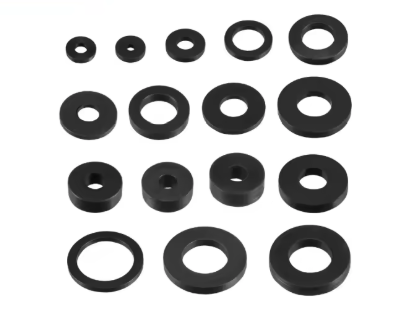
Types of Rubber Seals
The right seal configuration depends on your hardware geometry, whether there is relative motion between mating surfaces, and the direction of the sealing load. Wayne Rubber manufactures across all major seal types.
Compress between two parallel flat surfaces with no clearance gap to manage. Used in pipe unions, end caps, valve bonnets, flanged connectors, and access covers. The most forgiving seal configuration for elastomeric materials. Use the Gland Calculator to size your face seal groove.
Compress radially into a bore (piston seals) or around a shaft (rod seals). Common in hydraulic cylinders, pneumatic actuators, and pump housings. Require tight diametral clearance control to prevent extrusion. Material and gland design are critical for reliable long-term sealing performance.
Custom-profiled seals for electrical enclosures, equipment cabinets, access panels, and junction boxes requiring IP-rated environmental protection against dust, water ingress, and weathering. EPDM and silicone are the most common materials for this application type.
Molded seals with a flexible sealing lip that maintains contact with a rotating or reciprocating shaft. Used in rotary shaft applications, gearboxes, and wheel hubs where continuous shaft motion requires a seal that can accommodate movement without excessive friction or wear.
Rubber Seal Capabilities
- Compression Molded Seals: for standard profiles and medium-to-high production volumes
- Injection Molded Seals: tight tolerances and minimal flash for precision sealing applications
- Transfer Molded Seals: for over-molded inserts and seals requiring precise material placement around hardware
- Die-Cut Flat Seals: cut from sheet stock for flat profiles, prototypes, and low-volume specialty requirements
- Bonded Seals (Rubber-to-Metal): elastomer bonded to metal for structural sealing assemblies and vibration-isolating seal carriers
- Custom Profile Seals: any cross-section geometry molded to your drawing with full tooling design included
Static vs. Dynamic Sealing
Static Seals
In static applications there is no relative motion between the seal and mating surfaces after assembly. This covers the large majority of rubber sealing applications. Face seals, flange seals, enclosure gaskets, pipe joint seals, and port seals are all static. Static seals tolerate more squeeze and are more forgiving of surface finish variation than dynamic seals.
The primary long-term concern in static sealing is compression set, the tendency of rubber to take a permanent deformation under sustained load, gradually reducing sealing force. Compound selection and proper gland fill design both directly affect compression set performance over the service life of the seal.
Dynamic Seals
Dynamic seals must maintain sealing contact under relative motion between surfaces. Reciprocating hydraulic seals, rotary shaft seals, and valve stem seals are dynamic applications. Material selection is more constrained: the compound must resist abrasion, maintain consistent sealing force through the motion cycle, and not generate excessive heat through friction.
Surface finish on the dynamic sealing surface is critical. Parker ORD 5700 recommends 8 to 16 RMS on the sealing surface and 16 to 32 RMS on groove walls for reciprocating o-ring seals. Tighter squeeze ranges (10 to 22% of cross-section diameter) are used for dynamic applications to limit friction. Wayne Rubber’s engineering team evaluates dynamic seal requirements in detail before specifying compound or geometry.
Seal Materials
Material selection for seals is driven by the operating fluid, temperature range, whether the seal is static or dynamic, and any regulatory requirements. Wayne Rubber works with a network of rubber compounders to source the right grade across all major elastomer families.
Water, steam, HVAC, outdoor weathering, and glycol brake fluid. The standard choice for water system sealing and non-oil-wetted automotive applications.
EPDM Seals →Aggressive chemicals, fuels, and continuous service to +400°F. The correct specification when no standard elastomer survives the operating environment.
FKM Seals →Petroleum oils, hydraulic fluid, and fuel resistance. The most widely used seal material in industrial and automotive applications involving oil or fuel.
Nitrile Products →Widest temperature range of any common seal material. FDA and USP Class VI grades for food processing, medical equipment, and outdoor electrical enclosures.
Silicone Products →General-purpose sealing with good ozone, weather, and moderate oil resistance. Widely used in HVAC equipment, refrigerant systems, and marine applications.
General Purpose View CR material data →Hydrogenated NBR for oil service at elevated temperatures, sour gas environments, and applications requiring better ozone and heat resistance than standard NBR.
High-Temp Oil Service View HNBR material data →Use Wayne Rubber’s Chemical Resistance and Material Selection Guide to screen compounds against your specific fluid, temperature, and regulatory requirements, or contact our engineering team to discuss your application directly.
Rubber Seal Applications
Why Choose Wayne Rubber for Seals
- Engineering Support at the Design Phase Our team reviews seal geometry, confirms material selection, and evaluates static vs. dynamic requirements before tooling is committed. This avoids costly redesigns and accelerates time to production.
- All Three Molding Processes Compression, transfer, and injection molding are all available in-house. We match the process to your seal geometry and production volume rather than limiting your design to whatever is most convenient to run.
- Broad Material Coverage Wayne Rubber’s compounder network provides access to standard and specialty grades across 12+ elastomer families, including FDA, USP Class VI, MIL-spec, and AMS-qualified compounds.
- Free Gland Design Tool The O-Ring Gland Calculator is available at no cost for engineers designing o-ring seal grooves. It covers all AS568 cross-section series for piston, rod, and face seal configurations.
- Consistent Quality Every seal batch is dimensionally inspected and verified against material specifications before shipment. ASTM, ISO, and MIL test standards are supported with full compliance documentation available.
Request a Quote for Custom Rubber Seals
Send us your drawing, describe your application environment, or tell us your fluid, temperature, and motion requirements. We will recommend the right material and manufacturing approach.