
Custom Rubber Caps
A rubber cap fits over a protrusion: a thread, stud, pipe end, fitting, or terminal. A rubber plug fits inside a bore. The fit geometry is opposite, the retention mechanism is different, and the failure modes are different. Caps fail by pulling off, inverting under internal pressure, or having walls that collapse rather than grip. Each failure mode is addressed by a specific geometry feature: a retention bead or undercut holds the cap on a thread; a reinforced base prevents inversion under backpressure; adequate wall thickness at the correct durometer prevents collapse. Catalog caps, designed to fit the widest possible range of sizes, compromise all three.
Wayne Rubber manufactures custom molded rubber caps for threads, studs, pipe ends, fittings, hex heads, terminals, and custom profiles in Wixom, Michigan. Compression and injection molded in any elastomer from natural rubber to FKM. Standard and custom geometries from drawing or sample.
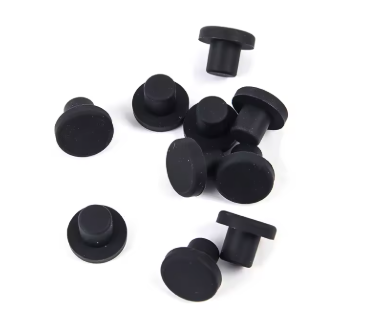
Custom Rubber Cap Configurations
The geometry of a rubber cap is determined by the shape of the protrusion it must cover, the retention force required, the environment it must seal against, and whether the cap is permanent or frequently removed. Wayne Rubber designs caps from these four primary configurations and their combinations.
A closed-bottom cylindrical cap that fits over a round tube, pipe end, or cylindrical fitting. The inside diameter of the cap is slightly smaller than the OD of the tube (interference fit) to create retention. Key design parameters: the ID-to-OD interference determines retention force; the cap depth determines how much of the tube it covers and how much surface area contributes to retention; wall thickness must be sufficient to maintain grip without the cap rolling or peeling off. For pipe-end protection during storage and shipping, a generous taper at the open end eases installation on slightly out-of-round tube ends. For sealing applications where the cap must exclude moisture or fluid, a sealing rib molded into the inner wall at a defined depth creates a contact seal without relying solely on the interference fit across the full cap length.
Caps designed to cover threaded fasteners (bolts, studs, hex heads, or threaded fittings) for protection during shipping, storage, or finishing operations. Round thread caps stretch over the exposed thread and retain by friction and interference against the thread crests. Hex caps have a hex interior profile that indexes to a specific fastener head size. Key retention feature: a retention bead or internal rib near the cap mouth that locks under the thread lead or fastener head prevents the cap from riding up and falling off during shipping vibration. Without this feature, round thread caps frequently work off of vibrating parts in transit. The retention bead is a simple molded feature but requires a custom tool; catalog thread caps omit it to fit multiple thread sizes. Silicone is the standard compound for masking thread caps used in powder coat and painting operations.
Caps for electrical terminals, connector pins, and port openings on electrical and electronic equipment. Two distinct functions: protection caps exclude contamination and moisture from unused connectors and terminal posts during assembly and storage; insulating caps provide electrical insulation over live terminals where contact with an energized terminal is a safety concern. Critical distinction: protection caps can be any suitable elastomer; insulating caps must be molded from a non-conductive compound with known dielectric strength. Standard elastomers are electrical insulators, but carbon-filled or conductive compounds must be excluded from insulating cap specifications. EPDM is the standard for outdoor terminal protection caps; silicone for high-temperature and autoclave-sterilizable medical and lab equipment terminal caps.
A flanged cap combines the protective tube or fitting cover with a flange that seats against a face or panel surface. The flange serves two purposes: it limits how far the cap can be pushed onto the protrusion (establishing the insertion depth and therefore the interference contact area); and it seals against the mounting face to exclude contamination from the panel or housing around the protrusion entry point. Dust caps are a subset of flanged caps designed for repeated installation and removal by operators in service environments; quick-release retention clips, tethers to prevent loss, and standardized geometry for one-hand installation are common features designed into dust caps for frequent-access applications on hydraulic couplings, pneumatic fittings, and fluid transfer ports.
Dip Molding vs. Compression Molding: Why the Process Matters for Caps
Dip-molded vinyl caps are the most common catalog product from distributors like StockCap and MOCAP. A mandrel is dipped into liquid plastisol (PVC/vinyl), withdrawn, and the coating is cured. The process produces caps quickly with no hard tooling cost, which is why catalog distributors offer thousands of sizes. The resulting cap has a smooth outer surface and a relatively uniform wall thickness, but the wall thickness consistency is limited by the dip process, the inside surface mirrors the mandrel rather than a tool cavity, and the compound is limited to PVC or vinyl formulations that cannot match the temperature range, chemical resistance, or compression set performance of compression-molded rubber. Dip-molded vinyl is the correct choice for high-volume generic protection caps in non-demanding environments where cost per unit is the primary requirement and a standard size fits the application.
The practical limit of dip-molded vinyl: it softens above 180°F, has poor resistance to petroleum solvents, and cannot be formulated in the elastomer compounds required for high-temperature masking, chemical resistance, or USP/FDA-compliant applications. Engineers who have been using vinyl catalog caps and encountering premature softening, chemical attack, or regulatory compliance issues are the prime candidates for custom compression-molded rubber caps.
Compression-molded rubber caps are produced by placing uncured rubber compound in a tool cavity and curing under heat and pressure. The tool defines both the inner and outer profile of the cap precisely, producing consistent wall thickness, accurate retention geometry (beads, ribs, tapers), and dimensional repeatability across large production lots. The process supports any elastomer compound (NBR, EPDM, silicone, FKM, neoprene, natural rubber) and can incorporate complex internal geometry (retention beads, indexing features for hex caps, sealing ribs) that the dip process cannot replicate. Tooling cost is higher than dip molding but amortizes rapidly at production volumes above a few thousand units per year.
Injection-molded rubber caps offer the tightest dimensional tolerances and the best surface finish of the three processes, at the highest tooling cost. Appropriate for high-volume medical, precision electronic, and demanding industrial caps where wall thickness consistency within ±0.005″ and precise interference fit across the lot are required. Wayne Rubber can specify the correct process for each application during the engineering review, preventing the common outcome of over-investing in injection molding for applications where compression molding is accurate enough, or under-investing in dip-molded vinyl for applications that will fail at temperature or with chemical exposure.
Three Rubber Cap Failure Modes and How Geometry Prevents Each
Pull-off under vibration or handling. A rubber cap retained only by interference fit between a smooth inner wall and the protrusion OD will work off of vibrating assemblies in transit and off of parts handled frequently in assembly operations. The solution is a retention feature molded into the inner wall: a circumferential bead that locks into a thread groove or undercut, a tapered inner wall that increases grip as the cap is pushed further on, or a retention rib that snaps past a fastener head. The correct retention feature depends on the protrusion geometry and the expected handling frequency. For parts in vibrating shipping environments, Wayne Rubber’s engineering team calculates the pull-off force of the proposed geometry against the expected dynamic load before tooling is committed.
Inversion under backpressure. A cap over a port, pipe end, or fitting that experiences internal pressure (from pressurized system testing, from thermal expansion of trapped fluid, or from accidental pressurization) can invert. The closed end of the cap is pushed outward by the pressure, progressively peeling the cap off the protrusion from the inside out. Inversion resistance is increased by thickening the base of the cap relative to the walls, by using a stiffer (higher durometer) compound, or by adding a reinforcement rib at the cap base. For any cap application where the capped fitting may experience pressure before the cap is removed, inversion resistance should be specified and tested.
Wall collapse and loss of grip. A rubber cap whose walls are too thin relative to the ID, or too soft in durometer for the wall geometry, collapses radially when pushed onto the protrusion rather than stretching uniformly to grip it. A collapsed wall creates uneven contact with the protrusion and poor retention. The minimum wall thickness for reliable grip without collapse is a function of the cap ID, the durometer, and the interference fit. Smaller-diameter caps (under 1″ ID) can use thinner walls; larger caps require proportionally greater wall thickness to maintain shape during installation and in service. Wayne Rubber’s engineering team establishes minimum wall thickness during the design phase based on the protrusion size and the required retention force.
All three failure modes share a common root cause: the cap ID, wall thickness, and compound durometer were not designed together as a system for the specific protrusion geometry and retention requirement. Catalog caps compromise all three to fit the widest range of sizes. Custom caps engineered for one specific protrusion eliminate all three failure modes with a modest tooling investment that pays back rapidly in reduced field failures and simplified assembly operations.
Rubber Cap Applications by Industry
- Brake and fuel line fitting caps during assembly
- Thread protection on chassis fasteners during paint
- Connector housing dust caps on exposed harnesses
- Hydraulic port caps on pumps and valves in transit
- Sensor port caps during washdown and e-coat
- Hex-head caps over bolts in corrosive underbody locations
- Hydraulic coupling dust caps for frequent field access
- Pipe-end protection caps during storage and shipping
- Pneumatic port caps on manifolds and valves
- Stud and bolt protection caps during surface finishing
- Tube end caps on precision machined fluid lines
- Instrumentation port caps during hydrostatic testing
- Terminal insulating caps over live bus bar connections
- Connector port dust caps on panel-mount receptacles
- Coaxial port caps on RF equipment and antennas
- Battery terminal caps for safe storage and transport
- Ground stud insulating covers in electrical enclosures
- Sensor probe caps for storage and shipping protection
- Thread masking caps for powder coat oven cycling
- Stud caps during e-coat and wet spray operations
- Bore protection caps during anodizing and plating
- Threaded insert caps during media blasting
- Precision feature protection during thermal spray
- High-temp silicone reusable masking caps for repeat finishing
- Instrument tip caps for storage of delicate surgical tools
- Luer fitting caps on IV and fluid transfer assemblies
- Autoclave-compatible silicone port caps on reusable devices
- Sample tube end caps for laboratory specimen storage
- Sterile packaging seal caps for single-use device components
- FDA silicone caps for food processing equipment nipples
- Antenna port caps on outdoor communications equipment
- Through-hull fitting caps on boats during storage
- Trailer hitch ball covers for UV and salt protection
- Electrical terminal caps on outdoor power distribution
- Valve stem caps on outdoor industrial valves
- Fuel and hydraulic port caps on agricultural and construction equipment
Rubber Cap Compound Selection Guide
| Compound | Cap Applications | Key Properties | Avoid When |
|---|---|---|---|
| Silicone (High-Temp) | Powder coat and e-coat masking caps (reusable); medical device terminal and port caps (autoclave-compatible); food processing equipment caps (FDA-compliant); high-temperature outdoor electrical terminal caps | Survives 400-450°F powder coat oven cycling without softening or bonding; USP Class VI and FDA grades for medical and food; wide temperature range for outdoor service; low compression set for reliable grip after repeated installation/removal | Petroleum oil immersion; applications requiring the best grip on smooth metal surfaces (silicone’s low friction coefficient reduces retention on smooth ODs without a retention feature); cost-sensitive general protection where EPDM or neoprene is adequate |
| EPDM | Outdoor equipment port and terminal protection caps; irrigation and water system fitting caps; antenna and communications equipment port caps; general outdoor storage caps in UV and ozone exposure | Best outdoor UV and ozone resistance for caps in outdoor storage and service; good water resistance for wet-environment protection; available in NSF-61 grades for water system port caps; lower cost than silicone for outdoor-only applications | Petroleum oil or fuel contact; masking applications above 300°F; automotive underhood with oil splash exposure (neoprene better) |
| NBR | Hydraulic port and coupling dust caps; fuel system fitting protection caps; engine-bay terminal caps with oil splash exposure; automotive assembly-line caps in oily shop environments | Good petroleum oil and fuel resistance for caps in hydraulic and fuel system applications; standard compound for automotive assembly-line protection caps where oil exposure is routine; lower cost than FKM for oil-contact applications below 250°F | Outdoor UV and ozone without protection (cracks within months in direct sunlight); masking applications; steam and hot-water service |
| Neoprene | General-purpose industrial protection caps where moderate oil contact is possible; outdoor equipment caps with occasional fuel or oil splash; automotive exterior caps at body seams and drain holes | Balanced oil, UV, and ozone resistance for industrial and automotive exterior applications where the environment cannot be precisely characterized; more robust in mixed-environment storage than EPDM; moderate cost | High-temperature masking applications; sustained hydraulic or fuel immersion (NBR better); best-UV-resistance applications (EPDM better) |
| FKM | High-temperature fuel and hydraulic system port caps where NBR’s service limit is exceeded; caps on fittings in contact with aggressive chemicals or solvents; marine and outdoor fuel system caps in sustained UV alongside fuel exposure | Broadest chemical resistance for demanding cap applications; resists fuels, oils, concentrated acids, and aromatic solvents; highest service temperature of any standard elastomer for caps near heat sources | Cost-sensitive general protection or masking applications; low-temperature storage where FKM stiffens (below -15°F FKM loses compliance and grip) |
| Natural Rubber | High-grip caps on smooth metal protrusions where maximum retention without a molded retention feature is needed; caps on rubber tubing and flexible conduit ends where compliance-to-compliance gripping is required; laboratory equipment stopper-style caps | Highest surface grip coefficient; excellent tear resistance at cap mouth and retention bead locations; lowest cost for simple protection caps in clean indoor environments | Any outdoor UV or ozone exposure; petroleum fluid contact; masking or elevated temperature applications; long-term outdoor storage |
Also from Wayne Rubber
Request Custom Rubber Caps from Wayne Rubber
Provide the protrusion geometry (thread size, stud OD, hex size, or tube OD), operating environment (indoor, outdoor, oil-adjacent, masking temperature), retention requirement, and quantity. Wayne Rubber will design the cap geometry, specify the compound and process, and quote tooling and piece cost.