
Custom Rubber Plugs
Rubber plugs serve three fundamentally different functions that look similar on the outside but require very different geometries and compounds. A sealing plug must maintain fluid pressure in a pipe or port; its geometry needs a controlled interference fit and its compound needs to be compatible with the fluid being contained. A masking plug must survive powder-coating or plating temperatures repeatedly without degrading; its compound must be high-temperature silicone and its geometry needs to fit a range of hole sizes without leaking coating through. A protection plug caps open fittings during shipping and storage; its compound can be a low-cost EPDM or neoprene and its fit can be more generous. Specifying the same catalog plug for all three functions is where most plug specifications go wrong.
Wayne Rubber manufactures custom molded rubber plugs for sealing, high-temperature masking, and protection applications in Wixom, Michigan. Tapered, flanged, shouldered, and threaded-bore designs in any elastomer family, from prototype through production volumes.
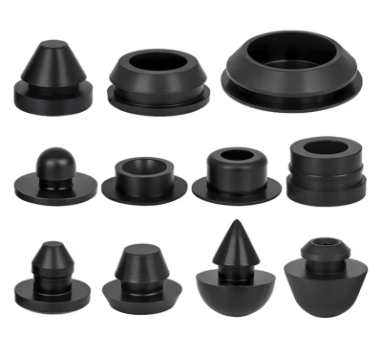
Sealing, Masking, and Protection: Three Different Design Problems
The term “rubber plug” encompasses three distinct functional categories that require different geometry logic, different compound selection, and different dimensional tolerancing. Understanding which function the plug must perform is the first step in any custom plug specification.
Seal a port, pipe end, or bore against fluid or gas pressure. The critical requirements: the compound must be chemically compatible with the fluid being sealed; the interference fit must be sufficient to resist the operating pressure without the plug ejecting; and the Shore A hardness must be low enough to achieve the seal without requiring excessive installation force. Typical geometry: tapered with a controlled interference, or flanged with a shoulder stop that prevents the plug from being pushed through the bore. Durometer range 30-60 Shore A. Compound selected for fluid compatibility: NBR for petroleum, EPDM for water and chemicals, silicone for high-temperature media, FKM for aggressive chemicals and high temperatures. RMA tolerancing must be tight enough to hold the interference fit across the lot.
Protect threaded holes, bores, and machined features during powder coating, e-coating, wet spray painting, anodizing, or plating operations. The critical requirements: the compound must survive repeated exposure to the process temperature (powder coat cure ovens typically reach 400°F for 20-30 minutes; e-coat curing reaches 350-400°F); the plug must not absorb or outgas contaminants that would affect the coating; and the geometry must create a reliable seal against coating penetration without becoming permanently bonded to the part. Typical compound: high-temperature silicone (rated to 400-450°F continuous). Tapered geometry fits a range of hole sizes. Color-coding by size is standard practice to speed installation. Single-use or multi-use grades available depending on the finishing process temperature and duration.
Cap open pipe ends, fittings, threaded ports, and machined surfaces during shipping, storage, and assembly operations to exclude contamination, damage, and moisture. The critical requirements: the plug must stay in place under shipping vibration without becoming so tight it cannot be removed; the compound must be compatible with the storage environment (UV-exposed outdoor storage, or chemical-ambient warehouse storage); and the plug must not leave residue on the part surface it contacts. Typical compound: EPDM or neoprene for general purpose; low-cost compounds acceptable since the plug is typically discarded before installation. Fit tolerance can be more generous than for sealing applications. Pull tabs, lanyards, and brightly colored compounds are common features for plugs that must be visually confirmed removed before assembly.
Custom Plug Geometry: How the Shape Determines the Function
The geometry of a rubber plug is not purely cosmetic. Each design feature has a specific engineering purpose related to how the plug retains itself in the bore, how it seals, how it installs, and how it removes. Understanding these geometry factors allows Wayne Rubber’s engineering team to design a plug that works the first time rather than requiring iterative tolerance adjustments after tooling.
The most common rubber plug geometry. The tapered body creates increasing interference as the plug is pressed into the bore, converting axial installation force into radial compression against the bore wall. Key design parameters: the taper angle (typically 2-8 degrees half-angle) controls how much force is needed per unit of axial travel; the minor diameter must be smaller than the bore for easy starting; the major diameter must be large enough to create the required radial sealing force at the final installed position. The problem with catalog tapered plugs: because one tapered plug is sold to fit a range of bore diameters, the installed position is not consistent. A custom tapered plug with a shoulder stop eliminates this variability by providing a hard stop that defines exactly how far the plug enters the bore, making the radial compression predictable and consistent across the lot.
A shouldered plug has a body sized to enter the bore with controlled interference and a flange or shoulder that contacts the face of the bore or pipe end, providing a hard stop that limits insertion depth. Key advantage over plain tapered plugs: the installed radial compression is determined by the body diameter, not by how far the installer pushes the plug. This makes the sealing force consistent and predictable regardless of installation technique. When to specify a shouldered plug: any application where consistent sealing performance across many installed plugs is required; pressure-rated sealing applications; and applications where the plug must be flush with or protrude a defined amount from the mating surface. The flange can also serve as a visual indicator that the plug is fully installed.
A rubber plug with a molded-in internal thread that engages the external thread of a fitting, bolt, or stud. The rubber body provides sealing and cushioning while the thread provides retention. Applications: protecting threaded studs from paint and coating during finishing operations; sealing fuel and hydraulic port plugs where thread engagement provides both seal and retention under pressure; and providing a removable protective cap for threaded fittings during storage and shipping. Design considerations: the thread must be molded accurately enough to engage the mating thread without cross-threading; the rubber body diameter must be sufficient to allow the threaded plug to be installed and removed by hand without excessive torque; and the rubber compound must not cold-flow under the sustained thread contact stress in long-term storage applications.
A sealing or protection plug with an integrated pull tab, ring, or lanyard attachment point molded into the rubber body during the molding process. Purpose: plugs that enter blind holes, deep bores, or recessed ports can be difficult to remove by gripping the plug body. A pull tab or ring provides a positive gripping surface for removal without tools. Safety-critical applications: in assembly operations where an un-removed plug would cause a downstream failure (hydraulic system plugs, pneumatic port plugs, intake and exhaust port plugs on engines being assembled), the pull-tab or lanyard is also used as a positive indicator that the plug has been removed before the system is closed. Brightly colored pull tabs and lanyards (typically red or yellow) are specified for plugs that must be confirmed removed before assembly.
Interference Fit: How Much is Enough and How Much is Too Much
The interference fit is the difference between the plug body diameter and the bore diameter at the installed position. Too little interference and the plug does not seal or does not stay in place. Too much interference and the plug requires excessive force to install, splits during installation, or permanently deforms into the bore and cannot be removed without damage.
The correct interference depends on two variables: the durometer of the rubber compound and the required sealing force (or retention force for protection plugs). A softer compound (30-40 Shore A) achieves the required sealing force with less interference than a harder compound (60-70 Shore A), because the softer material conforms more readily to the bore surface under less radial load. The relationship is not linear; a 10% change in interference produces a much larger percentage change in sealing force than a 10% change in durometer at equivalent interference.
For sealing plugs in pressure applications, Wayne Rubber’s engineering team calculates the minimum interference required to maintain the plug in place against the operating pressure plus a safety factor. The calculation considers the plug geometry (taper angle and contact area), the rubber modulus (which varies with durometer), and the bore surface finish (smooth machined bores require less interference than rough cast surfaces). This pre-tooling analysis prevents the common outcome of a plug that works correctly in the lab (with careful hand installation) but fails in production when installation is less consistent.
For protection plugs that must be removed cleanly, the upper interference limit is as important as the lower. A plug that is too tight bonds to the bore surface over time through adhesion and cold-flow, particularly in warm storage environments. Wayne Rubber specifies maximum body diameters for protection plugs to ensure that the plug can always be removed by hand after the intended storage period.
Rubber Plug Compound Selection by Application Type
| Compound | Plug Application | Key Properties | Avoid When |
|---|---|---|---|
| Silicone (High-Temp) | Powder coat and e-coat masking plugs; high-temperature sealing plugs for hot fluid ports; plugs in medical device sterilization applications; food processing equipment plugs requiring FDA compliance | Survives 400-450°F oven temperatures for masking; USP Class VI and FDA grades available; wide temperature range; low compression set; does not bond to most metal surfaces during powder coat cure; reusable across multiple coating cycles | Applications requiring petroleum oil resistance (silicone swells in oil); high-load press-fit into steel bores where silicone’s low friction causes the plug to walk out under vibration without a retention feature |
| EPDM | Water system port plugs; outdoor equipment storage plugs; aqueous chemical system sealing plugs; general-purpose protection plugs for weather-exposed storage | Best outdoor UV and ozone resistance for plugs stored outdoors in open fittings; good water and steam resistance; available in NSF-61 grades for water system applications; low cost for high-volume protection plug applications | Petroleum oil, hydraulic fluid, or fuel contact; masking applications above 300°F (high-temperature silicone required); applications requiring oil-resistance alongside outdoor weathering (neoprene or FKM) |
| NBR | Hydraulic port sealing plugs; fuel system port plugs; engine oil port sealing during assembly and storage; petroleum-system pipe-end sealing plugs for equipment in transit or storage | Best petroleum oil and hydraulic fluid resistance for sealing plugs; good compression set resistance for long-term port sealing; standard compound for hydraulic and fuel system port plugs; lower cost than FKM for oil-contact applications | Outdoor UV and ozone exposure without protection; masking applications (NBR degrades in coating oven temperatures); water system and steam applications where EPDM is required |
| Neoprene | General-purpose protection plugs in shop environments with oil splash potential; outdoor equipment port plugs where moderate oil contact is possible; pull-tab plugs for industrial assembly lines with mixed-fluid environments | Moderate oil and fuel resistance alongside moderate UV and ozone resistance; the balanced general-purpose compound for industrial plug applications where the environment cannot be precisely controlled; more chemical-robust than EPDM for shop floor storage | High-temperature masking applications; sustained hydraulic or fuel pressure sealing where NBR provides better sealing force retention; applications requiring best-possible UV aging (specify EPDM) |
| FKM | High-temperature fuel system port sealing plugs; aggressive chemical processing port plugs; hydraulic system plugs on equipment using synthetic hydraulic fluid; plugs in contact with hot petroleum fluids above NBR’s service limit | Broadest chemical resistance for demanding sealing plug applications; withstands concentrated acids, ketones, and aromatic solvents that defeat NBR and neoprene; specified when both high temperature and aggressive fluid resistance are simultaneously required | Cost-sensitive general protection or masking applications where silicone or EPDM perform adequately at lower cost; low-temperature storage environments below -15°F where FKM stiffens and loses sealing compliance |
| Natural Rubber | Laboratory bottle and flask stoppers (traditional one-hole and two-hole designs); pull-cord drainage plugs for tanks and vessels; abrasion-resistant plug body applications where grip against smooth metal surfaces is needed | Highest grip coefficient of any elastomer; traditional material for laboratory stoppers; good tear resistance at pull-tab attachment points; lowest cost per unit for high-volume simple protection plugs | Any petroleum fluid contact; outdoor UV or ozone exposure; masking applications; any application above 200°F; applications where long-term chemical resistance is required beyond dilute aqueous solutions |
Also from Wayne Rubber
Request Custom Rubber Plugs from Wayne Rubber
Provide the bore or port dimensions, operating pressure and fluid (for sealing plugs), process temperature (for masking plugs), retention and removal requirements, and quantity. Wayne Rubber will design the geometry, specify the compound, and quote tooling and piece cost.