
Rubber Vibration Mounts
Wayne Rubber manufactures custom rubber vibration mounts and isolation assemblies for industrial machinery, automotive applications, marine engines, and heavy equipment. Available as cylindrical isolators, sandwich mounts, conical mounts, and fully custom bonded rubber-to-metal assemblies, engineered to your specific load, deflection, and environmental requirements.
Effective vibration isolation starts with matching the mount’s natural frequency and static deflection to your application. Wayne Rubber’s engineering team works with your load and frequency data to specify the right geometry, compound, and durometer before tooling is committed.
How Rubber Vibration Isolation Works
Natural Frequency and Isolation
A rubber vibration mount acts as a spring-mass system. The mount’s natural frequency is determined by its stiffness (driven by compound, geometry, and durometer) and the mass it supports. Effective isolation occurs when the excitation frequency (the frequency of the vibration source) is significantly higher than the mount’s natural frequency, typically by a ratio of at least 1.4 to 1 and ideally 3 to 1 or greater.
Selecting a mount that is too stiff places the natural frequency too close to the excitation frequency, which can amplify rather than reduce vibration. This is the most common error in vibration mount selection and why static load rating alone is insufficient as a selection criterion.
Static Deflection and Durometer
Static deflection is the amount the mount compresses under the supported load at rest. It is directly related to natural frequency: higher static deflection produces a lower natural frequency and better isolation, but at the cost of greater movement under dynamic loads. The correct balance depends on the equipment’s sensitivity to motion and the amplitude of the vibration being isolated.
Durometer (Shore A hardness) controls stiffness. Softer compounds (40 to 50 Shore A) produce lower natural frequencies for a given geometry and are suited to low-frequency isolation. Harder compounds (60 to 80 Shore A) are used for higher load applications or where the mount must also control equipment sway and positioning under dynamic loads. Wayne Rubber’s network provides access to the full durometer range across all major elastomers.
Rubber Vibration Mount Types
Mount geometry determines the direction of vibration loading the mount handles most effectively, the available mounting interface, and the space envelope it occupies. Wayne Rubber manufactures all major mount configurations as custom molded parts.
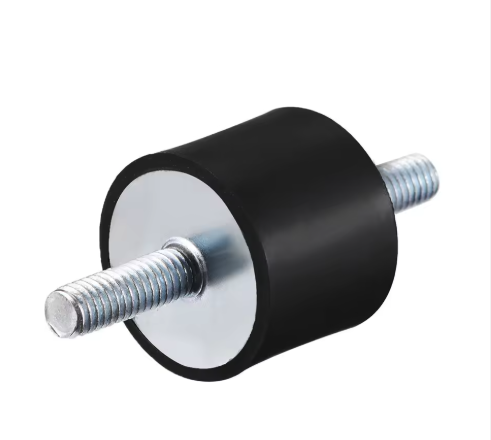
The most common vibration isolator geometry. A cylindrical rubber element bonded between two metal end plates or threaded inserts. Handles compression and shear loads in all radial directions. Used in electronics, instrumentation, small motors, and light equipment. Available in stud-mount, through-bolt, and captive-nut configurations.
A rubber element bonded between two flat metal plates. Provides high load capacity in compression and good isolation in shear. Common in machine tool mounting, generator sets, compressor bases, and industrial equipment where high static loads are combined with moderate vibration isolation requirements. Load ratings from a few pounds to several thousand pounds depending on size and compound.
A frustum-shaped rubber element that handles loads in both compression and shear simultaneously, offering multi-directional isolation from a single mount. The cone geometry provides a natural resistance to lateral sway while still isolating vertical vibration. Common in marine engines, diesel generator sets, and heavy industrial equipment with significant combined vertical and lateral loading.
Custom-designed rubber-to-metal bonded assemblies for automotive, marine, and industrial engine and motor isolation. Combine vibration isolation with controlled alignment of the powertrain under torque loads. Geometry, compound, and durometer are all specified to the engine’s mass, torque output, and operating speed range. Often designed with progressive rate characteristics to handle both idle and full-throttle conditions effectively.
Rubber bonded between inner and outer metal tubes, designed to isolate vibration between a shaft or pin and a surrounding housing. Used extensively in automotive suspension components, industrial linkages, and equipment with pivoting or rotating members where both vibration isolation and controlled articulation are required. See the Rubber Bushings page for details.
Fully engineered rubber-to-metal bonded isolation assemblies designed from scratch for your specific application. Wayne Rubber works from your dimensional drawing, load data, and isolation target to design the rubber geometry and select the compound. Custom assemblies are the right choice where standard mount geometries do not fit the available space or do not meet the isolation requirement.
Key Design Parameters
Provide the following information when requesting a custom vibration mount quote. The more detail you can supply, the more accurately Wayne Rubber’s engineering team can specify the right compound, geometry, and durometer.
| Parameter | Why It Matters |
|---|---|
| Supported Load | Total static weight carried per mount. Determines minimum load rating and sets the baseline for natural frequency calculation. |
| Excitation Frequency | The dominant vibration frequency of the source (e.g., engine RPM, motor speed, machine cycle rate). The mount’s natural frequency must be well below this value for effective isolation. |
| Isolation Target | Required vibration reduction, expressed as a percentage or in dB. Determines how far below the excitation frequency the mount’s natural frequency must be placed. |
| Available Space Envelope | Maximum dimensions for the mount in all three axes. Determines which geometries are feasible and whether a custom form factor is required. |
| Mounting Interface | Thread size, bolt pattern, flange dimensions, or stud configuration required to connect the mount to both the equipment and the structure. |
| Environmental Exposure | Operating temperature range, fluid or chemical exposure, outdoor weathering, and ozone exposure. Determines compound selection across natural rubber, neoprene, EPDM, NBR, and other elastomers. |
| Dynamic Load and Direction | Whether the mount primarily carries vertical compression, lateral shear, or combined multi-directional loads under operation. Affects geometry selection and determines whether a cylindrical, sandwich, or conical mount is most appropriate. |
Rubber-to-Metal Bonding for Vibration Mounts
Most rubber vibration mounts are rubber-to-metal bonded assemblies. The rubber isolation element is bonded directly to metal end plates, threaded inserts, or tubular housings during the molding process, producing an integrated component that does not rely on adhesives or mechanical retention in service.
Wayne Rubber bonds EPDM, nitrile, neoprene, natural rubber, and other elastomers to steel, aluminum, brass, and stainless steel substrates for vibration isolation assemblies, engine mounts, bushings, and bonded isolation pads. Metal preparation, primer application, and bonding are all part of the molding process.
Vibration Mount Applications
Vibration Mount Materials
The elastomer compound determines both the vibration isolation performance and the environmental durability of the mount. Wayne Rubber works with a network of rubber compounders to source the right grade across all major elastomer families.
The highest raw dynamic performance of any elastomer, with the lowest hysteresis, best fatigue life under repeated loading cycles, and excellent damping characteristics. The preferred material for general industrial vibration isolation where oil exposure is not present. Historically the dominant material for engine mounts and suspension bushings.
View NR data →Good vibration isolation performance with significantly better ozone, UV, and moderate oil resistance than natural rubber. The standard upgrade for outdoor and marine vibration mount applications where natural rubber would degrade from weathering exposure.
View CR data →Oil and fuel resistant vibration mounts for engine bays, hydraulic equipment areas, and any application where the mount will be exposed to petroleum-based fluids that would degrade natural rubber or neoprene.
View NBR data →Excellent ozone and weather resistance for outdoor HVAC equipment mounts, rooftop mechanical isolation, and any vibration mount application with extended UV and weathering exposure where neoprene’s oil resistance is not required.
View EPDM data →Wide temperature range from -75°F to +450°F for vibration isolation in high-temperature environments, exhaust-adjacent applications, and aerospace equipment where standard elastomers reach their thermal limits.
View silicone data →Hydrogenated nitrile for vibration mounts in hot oil environments and high-temperature engine applications where standard NBR reaches its thermal limits but the oil resistance of nitrile is still required.
View HNBR data →Why Choose Wayne Rubber for Vibration Mounts
- Application Engineering Effective vibration isolation depends on matching the mount’s natural frequency to your application. Wayne Rubber’s engineering team reviews your load, excitation frequency, and isolation target before specifying compound and geometry, not after.
- Rubber-to-Metal Bonding Most vibration mounts are bonded assemblies. Wayne Rubber bonds elastomers to steel, aluminum, brass, and stainless steel substrates in-house, producing integrated components across all major mount geometries. See our rubber-to-metal bonding capability page for detail.
- Custom Geometry When standard cylindrical, sandwich, or conical mount geometries do not fit your space envelope or do not meet your isolation requirement, Wayne Rubber designs and tools custom mount geometries from your drawing and performance specification.
- Full Elastomer Range Natural rubber, neoprene, nitrile, EPDM, silicone, and HNBR vibration isolation compounds are all available through Wayne Rubber’s compounder network across the full durometer range required for light to heavy-duty isolation applications.
- Prototype to Production Wayne Rubber supports development programs from initial prototype quantities through full production runs, with consistent compound and dimensional properties maintained across the transition from development to volume manufacturing.
Request a Quote for Custom Vibration Mounts
Provide your load per mount, excitation frequency or equipment RPM, available space envelope, mounting interface requirements, and operating environment. We will recommend the right geometry and compound.