
Rubber Bellows
Wayne Rubber manufactures custom molded rubber bellows and convoluted boots for automotive steering and suspension, industrial machinery, HVAC equipment, and aerospace applications. Available in concentric and spiral convolute designs, single and multi-convolution configurations, with integrated mounting flanges, clamp beads, and venting features, all molded to your dimensional drawing and stroke requirement.
Bellows design involves a specific set of engineering tradeoffs between stroke length, collapsed height, space envelope, and wall thickness. Wayne Rubber’s engineering team works from your application parameters before tooling is committed.
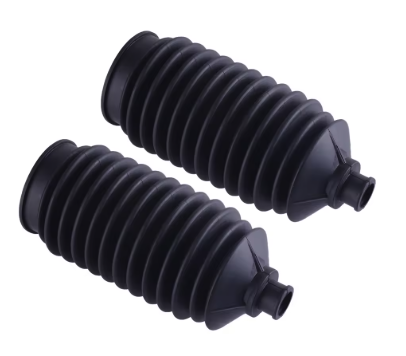
What Rubber Bellows Do
A rubber bellows is a flexible molded component that seals the interface between two relatively moving parts, allowing controlled linear, angular, or lateral motion while preventing dust, moisture, oils, and other contaminants from entering the protected assembly. The accordion-like convolutions expand and contract with the motion of the mechanism, accumulating and distributing flex stress across the full convoluted length rather than concentrating it at a single bend point.
Unlike a straight rubber sleeve, which can only accommodate limited motion before stretching to failure. A properly designed convoluted bellows can achieve large stroke ratios, often 3:1 or greater between the fully extended and fully collapsed length, without exceeding the material’s elastic limit. The number, depth, and geometry of the convolutions determine the stroke ratio, the force required to actuate the bellows, and the fatigue life under repeated cycling.
Bellows also function as expansion joints in fluid handling and HVAC systems, where they accommodate thermal growth, pipe misalignment, and pressure pulsation without transmitting those forces into the connected equipment or structure. In this role the bellows is static rather than cyclically actuated, and the design emphasis shifts from fatigue life to pressure rating and media compatibility.
Wayne Rubber manufactures molded rubber bellows for both dynamic (actuated) and static (expansion joint) applications. The two applications use similar materials and molding processes but have different design priorities. Providing Wayne Rubber’s engineering team with the application type, stroke or thermal movement requirement, and the fluid or environmental exposure is the starting point for any bellows quote.
Bellows Construction Types
The construction type determines the motion the bellows can accommodate, its stroke ratio, and what geometries are feasible in the available space envelope around the application.
The standard bellows construction. Concentric rings of convolutions allow linear compression and extension along the bellows axis. Suitable for applications with axial motion only. The most common construction for steering boots, CV joint boots, cylinder rod boots, and actuator dust covers. Available in single and multi-convolution designs.
Convolutions arranged in a spiral rather than concentric rings. Accommodates combined axial and angular motion, better suited to applications where the bellows must flex in multiple directions simultaneously, such as CV axle boots, rack-and-pinion steering boots, and ball joint boots where angular articulation accompanies axial stroke.
The bellows has a larger diameter at one end than the other, fitting applications where the two attachment interfaces are different sizes. Common in telescoping cylinder applications, conical space envelopes, and assemblies where the protected component changes diameter along its travel path. Requires careful convolute design to achieve uniform wall stress at full extension.
A straight cylindrical sleeve without convolutions. Suitable for very short stroke applications or where the primary function is environmental protection rather than accommodating significant motion. Lower tooling cost than convoluted designs. Also used as protective covers on cylinders and shafts where angular bending rather than linear stroke is the motion type.
Multi-convolution bellows designed for static or low-cycle expansion joint service in piping, HVAC ductwork, and fluid handling systems. Accommodates thermal growth, pipe misalignment, and vibration without rigid pipe connections. Rated for internal pressure as well as axial movement. Material selection driven by process fluid compatibility and temperature.
A woven fabric layer embedded in or applied to the rubber wall adds strength under internal pressure and improves resistance to mechanical abrasion on the exterior. Common in high-pressure expansion joints, pneumatic actuator boots in abrasive environments, and any application where the rubber wall would be too thin without reinforcement to meet the pressure rating.
Key Design Parameters
Bellows design requires specifying several interrelated geometric parameters that all affect each other. Wayne Rubber’s engineering team evaluates these collectively from your application requirements before recommending a convolute geometry and wall thickness.
| Parameter | What It Controls |
|---|---|
| Stroke Length | The total travel from fully collapsed to fully extended. Determines the minimum number of convolutions required. Longer strokes need more convolutions or deeper convolution profiles. |
| Collapsed Height | The bellows length in its compressed state. Sets the minimum available installation space at one end of travel. Must be greater than the sum of all wall thicknesses in the convoluted section. |
| Outer Diameter / Space Envelope | The maximum available diameter around the bellows at peak convolution. Constrains how deep each convolution can be, which in turn determines how many convolutions are needed to achieve the required stroke in the available collapsed height. |
| Number of Convolutions | More convolutions distribute stroke across more flex cycles per convolution, reducing peak strain at each fold and extending fatigue life. More convolutions also increase collapsed height for a given stroke length. |
| Wall Thickness | Thinner walls flex more easily and produce lower actuation force, but reduce fatigue life and pressure rating. Thicker walls increase durability and pressure capability at the cost of higher actuation force and increased collapsed height. |
| End Interface / Mounting | How the bellows attaches to the mating hardware at both ends: clamp bead, retaining groove, flange with bolt holes, press-fit spigot, or integrated grommet. Must be designed into the mold; cannot be added post-mold without tooling changes. |
| Venting | In sealed bellows applications, air trapped inside the convolutions must be able to move as the bellows compresses. Without venting, the internal air pressure acts against compression, increasing actuation force and potentially causing the bellows to balloon. Vent holes are typically molded into the convolution peaks or collar area. |
Bellows Manufacturing Capabilities
- Compression Molding: for simple profiles, large cross-sections, and lower volumes where tooling cost is the primary constraint
- Transfer Molding: for more complex geometries, integrated inserts, and fabric-reinforced constructions requiring controlled material placement
- Injection Molding: for high-precision thin-wall bellows requiring tight dimensional repeatability at moderate-to-high volumes
- Single and Multi-Convolution: any number of convolutions designed to your stroke and collapsed height requirements
- Integrated Features: clamp bead grooves, attachment flanges, vent holes, grommet ends, and mechanical retention features molded in
- Fabric Reinforcement: nylon or polyester fabric integrated for pressure-rated expansion joint applications
- RMA A2 Tolerances: molding tolerances compliant with Rubber Manufacturers Association A2 precision standard
- Prototype to Production: development quantities through full production runs
Rubber Bellows Applications
Bellows Materials
Bellows compound selection is determined by the external environment (dust, moisture, oil, UV, ozone, temperature) and for expansion joint applications, the internal fluid compatibility. Fatigue life under repeated flexing is also compound-dependent; compounds with higher elongation at break and lower hysteresis accumulate fatigue damage more slowly under cyclic motion.
The most common bellows compound for general industrial and automotive applications. Good ozone, UV, and moderate oil resistance with good fatigue characteristics. Standard choice for steering boots, cylinder rod covers, and general machinery boots.
View CR data →The highest raw fatigue life of any elastomer under repeated flex cycling. Preferred for high-cycle dynamic bellows applications where longevity under motion is the primary requirement and outdoor weathering exposure is limited.
View NR data →Excellent ozone, UV, and weather resistance for outdoor and marine bellows applications. Good hot water and steam resistance for HVAC expansion joints. Not suitable for petroleum fluid contact on either interior or exterior surfaces.
View EPDM data →Oil and fuel resistant bellows for engine bay, hydraulic, and fuel system applications where the boot exterior is wetted with petroleum-based fluid. The correct choice when neoprene would swell from oil contact on the boot surface.
View NBR data →Wide temperature range for high-temperature bellows in exhaust-adjacent locations, turbocharged engine bays, and industrial oven applications. FDA grades available for food processing equipment boots. Lower fatigue life than neoprene or natural rubber under high-cycle dynamic applications.
View silicone data →For bellows in aggressive chemical environments involving fuels with aromatic content, solvents, and high-temperature service above 250°F where neoprene and NBR are degraded. Specify only where the chemical or temperature environment requires it.
View FKM data →Why Choose Wayne Rubber for Bellows
- Engineering Review Before Tooling Bellows geometry involves interrelated tradeoffs between stroke, collapsed height, space envelope, and wall thickness. Wayne Rubber reviews your application parameters and hardware drawing before recommending a convolute geometry — avoiding tooling commits that require revision when the first prototype doesn’t collapse to the required height.
- All Three Molding Processes Compression, transfer, and injection molding are all available in-house. The right process for a bellows depends on wall thickness, convolute geometry, and production volume. We match the process to the part, not the other way around.
- Integrated Mounting Features Clamp bead grooves, flanges, grommet ends, vent holes, and mechanical retention features are all designed into the mold. Wayne Rubber designs the bellows interface in conjunction with the hardware drawing to ensure both are compatible before either is committed to tooling.
- Broad Material Coverage Neoprene, natural rubber, EPDM, nitrile, silicone, and FKM bellows compounds are all available through Wayne Rubber’s compounder network. Material selection is matched to your specific environmental exposure, temperature range, and fatigue cycle requirement.
- Prototype to Production Wayne Rubber supports bellows programs from initial prototype quantities through full production, with consistent dimensional and compound properties maintained across the transition.
Request a Quote for Custom Rubber Bellows
Provide your dimensional drawing or describe your application: stroke length, collapsed height, space envelope, motion type, and environment. Wayne Rubber will evaluate the design and quote.