
Rubber Bushings
Wayne Rubber manufactures custom rubber bushings for vibration isolation, suspension linkages, structural pivots, and load-control applications in automotive, industrial, agricultural, and construction equipment. Available as plain cylindrical sleeves, bonded rubber-to-metal assemblies with inner and outer metal tubes, and press-fit sleeve bushings, all engineered to your load direction, stiffness, and environmental requirements.
Bushing performance depends on the interaction between compound, geometry, and load direction. Wayne Rubber’s engineering team evaluates all three before recommending a design, so stiffness and fatigue life are matched to the application rather than left to defaults.
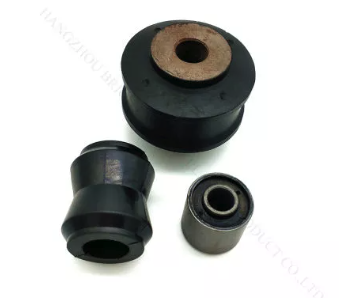
How Rubber Bushings Work
A rubber bushing provides a compliant interface between two structural members, allowing controlled relative motion while transmitting load. The rubber element deforms elastically under applied force, isolating vibration and absorbing shock without transmitting it rigidly to the adjacent structure. When the load is removed, the rubber recovers, returning the parts toward their neutral position.
The stiffness of a rubber bushing in any given direction is determined by three variables: the rubber compound’s shear modulus (which correlates with, but is not identical to, Shore A durometer), the geometric dimensions of the rubber element, and the direction of loading relative to the bushing axis. Rubber in compression is far stiffer than rubber in shear for the same geometry. This means a cylindrical bushing presents different stiffness values in the axial, radial, and torsional directions simultaneously, a property that is exploited in suspension bushing design but must be accounted for in any load-bearing bushing application.
For bonded rubber-to-metal bushings, the rubber is chemically bonded to inner and outer metal tubes during the molding cycle. The assembly is then pressed or bolted into the surrounding structure. Because the rubber is bonded rather than mechanically retained, it can transmit tensile and shear loads in any direction without the rubber element shifting or extruding under load. Bonded bushings are the correct design for suspension pivot points, engine mounting brackets, and any application where load reversal or multi-directional loading would allow a mechanically retained rubber element to migrate out of position.
For plain sleeve bushings without metal tubes, the rubber is pressed directly into a housing bore or over a shaft. These are simpler to manufacture and install but are limited to applications where the loading is primarily compressive and the bushing geometry provides sufficient mechanical retention against dislodgement.
Rubber Bushing Types
Rubber bonded between concentric inner and outer metal tubes. The most common type for suspension control arms, stabilizer bar links, and structural pivot points. Provides predictable stiffness ratios between radial, axial, and torsional directions. Inner tube carries the bolt; outer tube presses into the housing bore. Load is transmitted through the bonded rubber in shear.
Rubber sleeve without bonded metal tubes, pressed over a shaft or into a bore. Lower cost and simpler installation than bonded types. Appropriate for applications with primarily compressive or torsional loading where the housing geometry provides radial retention. Common in pivot pins, linkage joints, and structural hinge points with limited load reversal.
A cylindrical bushing with an integrated radial flange at one or both ends. The flange bears axial load and acts as a built-in washer, eliminating the need for a separate thrust washer. Common in pivot applications where axial retention and load distribution across a wider face area are required alongside the radial compliance of the cylindrical section.
Rubber bonded between tapered inner and outer metal surfaces rather than cylindrical ones. Conical geometry produces a stiffer response in the axial direction relative to radial compliance, making these bushings useful in suspension and cab mount applications where high axial load capacity is required alongside controlled radial deflection under lateral inputs.
Load Direction and Stiffness
The most important design input for a rubber bushing is the direction and magnitude of the service load relative to the bushing axis. Rubber responds very differently to compression, shear, and tension. A bushing correctly sized for its radial load may be far too soft or far too stiff in the axial or torsional direction if these are not evaluated simultaneously.
| Load Mode | Relative Stiffness | Design Notes |
|---|---|---|
| Radial (perpendicular to axis) | Medium to high | The primary load mode for most suspension and linkage bushings. Stiffness is controlled by wall thickness, rubber length, and compound modulus. Increasing wall thickness softens radial stiffness; increasing rubber length stiffens it. |
| Axial (along the bushing axis) | Low to medium | Rubber in shear along the axis is inherently softer than in radial compression. Flanged designs and longer bond lengths increase axial stiffness. Important to evaluate if the application sees significant thrust loads alongside radial loads. |
| Torsional (twist about axis) | Low | Rubber in torsion is the softest mode. Bonded bushings accommodate angular articulation at the pivot point without requiring a separate bearing. Torsional stiffness is set by rubber volume and compound; critical in suspension pivots where camber and toe change under articulation must be controlled. |
| Conical (combined axial and radial) | Tunable | Conical geometry shifts the stiffness ratio between axial and radial modes relative to cylindrical designs. Used when a specific axial-to-radial stiffness ratio is required that cannot be achieved with a standard cylindrical bushing wall thickness. |
Why Natural Rubber Leads in High-Cycle Bushing Applications
For dynamic bushing applications involving millions of load cycles (automotive suspension, off-highway equipment, compressor mounts), natural rubber is the preferred compound and has been for over a century of bushing engineering. The reasons are specific and worth understanding before selecting an alternative:
Natural rubber has the lowest hysteresis of any common elastomer, meaning it dissipates the least energy as heat per load cycle. In a bushing cycling thousands of times per hour, low hysteresis translates directly to lower heat buildup at the rubber-metal bond line, and heat buildup is the primary mechanism by which dynamic bushings degrade and ultimately debond. Natural rubber also has the highest fatigue life under repeated flex cycling of any commodity elastomer, outperforming neoprene, NBR, and EPDM in high-cycle dynamic testing by a significant margin.
The limitation of natural rubber is environmental resistance: it has poor resistance to ozone, UV, oils, and fuels. For bushings with outdoor exposure or oil-wetted surfaces, neoprene provides a useful balance of fatigue life and environmental resistance. For bushings in direct petroleum fluid contact, NBR is required despite its higher hysteresis. The compound selection table below summarizes the practical tradeoffs.
Bushing Compound Selection
Best fatigue life and lowest hysteresis of any commodity elastomer. First choice for high-cycle dynamic bushings in protected environments. Not suitable for outdoor UV/ozone exposure or any petroleum fluid contact.
View NR data →Good fatigue life with the addition of ozone, UV, and moderate oil resistance. The standard upgrade from natural rubber for outdoor or underhood applications with limited petroleum fluid contact. Widely used in marine engine mounts and outdoor structural pivots.
View CR data →Required when the bushing exterior is wetted with petroleum oil, hydraulic fluid, or fuel. Higher hysteresis than natural rubber or neoprene; not ideal for the highest-cycle dynamic applications but necessary where oil contact makes natural rubber or neoprene unsuitable.
View NBR data →Excellent ozone and UV resistance for outdoor structural pivot bushings not in contact with oil. Good low-temperature flexibility. Used in construction equipment pivot points and outdoor HVAC structural isolation applications where weathering resistance is the primary driver.
View EPDM data →Hydrogenated nitrile for applications combining oil resistance with elevated temperature service. Used in engine-adjacent bushings where oil contact and temperatures above nitrile’s continuous limit are both present. Substantially better heat aging than standard NBR.
View HNBR data →Styrene-butadiene rubber blended with natural rubber for cost-effective general-purpose bushings. Lower cost than pure natural rubber compounds with acceptable fatigue life for moderate-cycle industrial applications. Not suitable for oil contact or outdoor weathering without protective coating.
View SBR data →Rubber Bushing Applications
Bushing Manufacturing Capabilities
- Rubber-to-Metal Bonding: chemical bonding of rubber to steel, aluminum, stainless, and brass substrates during the molding cycle
- Transfer Molding: preferred process for bonded bushings; lower injection pressure protects insert position during mold fill
- Compression Molding: for plain sleeve bushings, flanged bushings, and high-durometer designs requiring long cure cycles
- Injection Molding: for high-volume bonded bushings requiring tight dimensional repeatability
- Metal Tube Supply: Wayne Rubber can source inner and outer metal tubes to your specification for bonded assemblies
- Surface Preparation: grit blasting, solvent cleaning, and two-coat adhesive systems applied before molding
- ASTM D429 Bond Testing: destructive peel, shear, and tensile testing per ASTM D429 available for bond strength verification
- Custom Durometers: 40 to 90 Shore A compounds available across all listed elastomer families
Why Specify Wayne Rubber for Bushings
- Stiffness-First Engineering Wayne Rubber evaluates load direction, deflection requirement, and fatigue cycle count before recommending a compound and geometry. Stiffness and durometer are specified together, not independently.
- Bonded Assembly Expertise Rubber-to-metal bonded bushings require correct surface preparation, adhesive system selection, and molding process control to achieve bond strength that matches or exceeds rubber tensile strength. Wayne Rubber’s bonded assembly process is reviewed on the Rubber-to-Metal Bonding capability page.
- Natural Rubber Compounds Available Natural rubber is the correct first choice for high-cycle dynamic bushings but is less commonly stocked by distributors focused on synthetic compounds. Wayne Rubber’s compounder network provides natural rubber and NR/SBR blend compounds for high-fatigue bushing programs.
- Metal Insert Sourcing For bonded bushing programs, Wayne Rubber can source inner and outer metal tubes to your drawing rather than requiring the customer to deliver pre-machined inserts. This simplifies procurement and ensures the insert dimensions match the mold geometry.
- Wixom, MI Manufacturing Wayne Rubber manufactures in Wixom, Michigan, 20 miles from Detroit — in the center of North American automotive and industrial supply chain. Short lead times and direct engineering communication without offshore coordination.
Request a Quote for Custom Rubber Bushings
Provide your dimensional drawing, load direction, stiffness or deflection requirement, annual volume, and environment. Wayne Rubber will evaluate the design and quote.