
Blog
Rubber in Pet Products | Compound Selection Guide
Jun
The pet products market is one of the most rapidly growing consumer goods categories in the United States, with pet industry spending exceeding $150 billion annually and rubber components appearing in nearly every product subcategory from chew toys and lick mats to automatic feeders, agility equipment, and orthopedic beds. For product developers and OEM manufacturers sourcing rubber components for pet products, the compound selection decisions are more consequential than they appear: the same FDA food-contact compliance requirements that govern human food processing equipment apply to rubber that contacts animal food and saliva, no federal standard specifically governs pet toy safety creating a compliance vacuum that responsible manufacturers fill voluntarily, and the mechanical requirements for a chew toy that must survive thousands of biting cycles from a 90-pound Rottweiler are genuinely demanding engineering problems that generic rubber catalog sheets do not address.
The Regulatory Landscape: Why Compliance Is Both Simpler and More Complex Than It Appears
Pet product rubber safety in the United States operates in a regulatory gap that surprises most product developers encountering it for the first time. The FDA does not regulate pet accessories including toys, beds, and crates. The Consumer Product Safety Commission (CPSC) focuses on human-use products and only intervenes in pet products when there is a direct risk to human safety. There is no federal equivalent of the Consumer Products Safety Improvement Act (CPSIA) for pet toys that mandates heavy metal testing or phthalate limits the way children’s toy regulations do.
This does not mean that anything goes. It means that the compliance framework for pet product rubber is a combination of voluntary standards, food-contact regulations that apply where the rubber contacts food or treats, and the manufacturer’s exposure to product liability claims and consumer backlash if a compound causes harm. Reputable manufacturers, particularly those selling in premium retail and those manufacturing in the United States, voluntarily apply the same standards that govern children’s toys, specifically EN 71-3 (migration of hazardous elements including heavy metals) and the FDA’s 21 CFR 177.2600 food-contact rubber standard. The result is a two-tier market: premium domestic manufacturers holding themselves to rigorous voluntary standards, and lower-cost imported products where compliance documentation is inconsistent or absent.
The FDA food-contact rubber standard (21 CFR 177.2600) is the most relevant federal regulation for rubber pet products. It applies to rubber articles intended for repeated food contact, and its scope extends to pet feeding products where rubber contacts animal food, treats, or saliva. Rubber pet bowls, lick mats, treat-dispensing toys, and any rubber component that food passes through or that an animal mouths during eating is arguably within scope of 21 CFR 177.2600. The standard governs which polymer base compounds, vulcanization agents, fillers, and processing aids are permitted in food-contact rubber, and applies the same extractables framework as food-contact rubber for human applications.
For product developers, the practical implication is that rubber compounds intended for chew toys, lick mats, treat-dispensing toys, and feeding accessories should be sourced with FDA 21 CFR 177.2600 compliance documentation, not because federal enforcement requires it but because the product liability exposure from a compound that fails to meet that standard, if an animal is harmed, is significant. Wayne Rubber’s compounder network supplies FDA 21 CFR 177.2600 compliant compounds in natural rubber, EPDM, silicone, and NBR across the durometer range relevant to pet applications.
Rubber Compound Selection Across Pet Product Applications
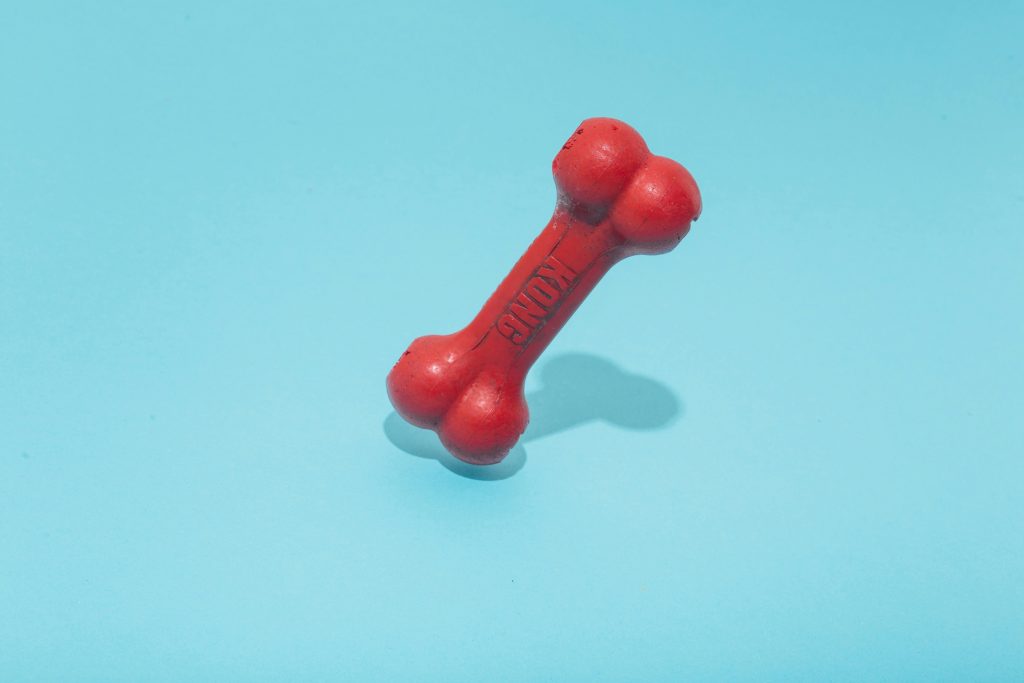
Natural rubber is the dominant compound for premium dog chew toys because it uniquely combines the properties that this application requires: high tear resistance that prevents fragmentation into ingestion-hazard pieces, adequate hardness to resist complete destruction by aggressive chewers, sufficient flex resilience to survive millions of biting cycles without stress cracking, and a natural origin that supports the “non-toxic and natural” positioning that drives premium pet product purchasing decisions.
Shore A hardness is the most consequential specification decision for chew toys. A toy that is too hard can fracture a dog’s teeth, causing significant veterinary cost and welfare harm. A toy that is too soft is destroyed rapidly by aggressive chewers, producing fragments. The veterinary consensus, reflected in the American Veterinary Dental College’s guidelines, is that rubber toys should flex under hand pressure: if the toy does not yield when you press your thumbnail into it, it is too hard and risks tooth fracture in dogs. This translates to a maximum hardness of approximately 80-85 Shore A for direct chewing applications. The appropriate range by dog category is:
| Dog category | Recommended Shore A range | Compound rationale | Key failure mode to avoid |
|---|---|---|---|
| Puppy / senior (gentle chewer) | 40-55 Shore A | Soft natural rubber or silicone. Compliant enough for teething or sensitive teeth without dental injury risk. | Fragmentation: too-soft compounds tear apart, creating ingestion hazard fragments from small pieces. |
| Small to medium dog (moderate chewer) | 50-60 Shore A | Medium-hard natural rubber. Balances durability with dental safety. | Over-hardening: sourcing harder compound to improve durability at the cost of tooth safety. |
| Large dog / power chewer | 55-65 Shore A | Hard natural rubber, specifically formulated for heavy chewer durability. | Tooth fracture: exceeding 80 Shore A creates tooth fracture risk in dogs. Do not exceed to chase durability. |
| Aggressive / extreme chewer | 60-75 Shore A maximum | Premium natural rubber with optimized tear resistance. Safety indicator systems signal when replacement is needed before fragmentation occurs. | Both fragmentation AND tooth fracture: the design challenge is durability without hardness. Achieved through compound formulation, not hardness alone. |
Tear resistance, not hardness, is the correct engineering lever for heavy chewer durability. The instinct to increase Shore A hardness to improve chew toy longevity is the most common compound specification error in this category. A harder compound resists initial penetration but is more brittle under repeated bending and tearing stress, ultimately fragmenting in fewer cycles than a properly formulated lower-hardness compound with optimized tear strength. ASTM D624 tear strength data (die C or die B) is a more relevant specification for chew toy durability than Shore A alone. Specifying minimum tensile strength of 15 MPa and minimum elongation at break of 300% alongside the Shore A range gives the compounder the correct targets for a durable, fragment-resistant chew toy compound.
The latex allergy consideration: Natural rubber latex contains proteins (primarily Hevea proteins, especially Hev b) that can trigger Type I hypersensitivity reactions in dogs with latex allergy, a condition that is recognized but uncommon in the canine population. For brands targeting veterinary or health-conscious channels where latex allergy avoidance is a concern, synthetic polyisoprene (a synthetic equivalent to natural rubber’s chemistry without the Hevea proteins) or thermoplastic rubber (TPR) compounds can provide similar mechanical properties without the allergenic protein content. This is a niche specification but relevant for brands positioning for the premium veterinary or allergenic pet market.
Lick mats are flat or textured rubber surfaces on which food, treats, or spreadable foods (peanut butter, yogurt, wet food) are applied for dogs and cats to lick as an enrichment activity. The compound requirements are completely different from chew toys: lick mats are not subjected to biting forces or tear loading, but they are in continuous food contact, require repeated dishwasher cleaning, must not accumulate bacteria in surface texture features, and must comply with FDA food-contact requirements for the food categories that pet owners apply to them.
Platinum-cured silicone is the correct specification for lick mats and slow feeder inserts. Its combination of properties is uniquely suited to this application: FDA food-contact compliance with very low extractables (platinum catalyst leaves no residue that would affect food chemistry or safety), dishwasher-safe temperature resistance to 200°C+ that allows high-temperature sanitization, the ability to mold complex texture geometries (ridges, channels, bumps, and pockets that slow feeding and provide enrichment) with dimensional accuracy, and a non-porous surface that does not harbor bacteria between cleanings. The non-stick surface release of silicone also ensures that food does not bond permanently to the mat surface, which would make cleaning incomplete and promote bacterial growth.
The appropriate durometer for lick mats is 30-50 Shore A, soft enough to allow the surface texture to flex during cleaning and to prevent the mat from sliding on hard floors when the dog applies licking pressure. The suction cup foot features on many commercial lick mats are molded from the same or lower durometer silicone to provide the compliance needed for reliable floor grip. Peroxide-cured silicone is acceptable for some lick mat applications but platinum-cured grades are preferred because their lower extractables profile reduces any concern about residual cure agent contact with food applied to the mat surface.
Why natural rubber is not the correct specification for lick mats: Natural rubber provides adequate food-contact compliance under FDA 21 CFR 177.2600 in appropriate formulations, but its surface properties are less suitable for the lick mat application than silicone. Natural rubber has higher surface tackiness than silicone, which causes food to adhere more strongly to the surface and makes cleaning less complete. Natural rubber also does not provide the same dishwasher temperature stability as silicone, and its surface can absorb odors from strongly flavored foods over multiple use cycles in a way that silicone does not. For the specific combination of food contact, repeated cleaning, and enrichment use that lick mats require, silicone is the better compound specification.
Silicone collapsible bowls for travel and outdoor use have become a mainstream pet product category. The bowl must hold water or food without deformation under the animal’s weight applied to the rim, collapse flat for transport, expand reliably to full volume for use, and resist the UV exposure of outdoor and travel use without degradation. Platinum-cured silicone at 50-70 Shore A provides the necessary combination of structural integrity in the deployed state, flexibility for collapse, and UV stability for outdoor use. The FDA food-contact compliance of platinum-cured silicone is appropriate for bowls that contact both dry and wet food and water.
Automatic feeder and water dispenser seals present a more industrial sealing application within the pet product category. Automatic pet feeders use timer-controlled dispensing mechanisms; pet water fountains recirculate water through filtration systems. Both contain rubber gaskets, O-rings, and valve seals that are in continuous contact with pet food or water. The compound requirements for these seals mirror the requirements for food processing equipment seals: FDA 21 CFR 177.2600 compliance, resistance to the dishwasher cleaning cycles used to maintain hygiene, and compression set resistance to maintain sealing integrity over the product’s service life without requiring seal replacement.
Peroxide-cured EPDM is the appropriate specification for static gaskets and seals in pet feeder and water fountain housing joints where oil or fat contact from pet food is not present. For water fountain pump seals and valve seals where water contact is continuous, peroxide EPDM with low ionic extractables (the same ionic leachables requirement that governs DI water system sealing) is the correct specification. FDA silicone O-rings are preferred for any seal in direct contact with pet food dispensing mechanisms where fat and oil content from the food could contact the seal surface, because EPDM’s compatibility with fatty food constituents over extended contact periods requires specific formulation validation.
Dog agility training equipment, including contact obstacles such as A-frames, dog walks, and seesaw contact zones, uses rubber surfacing to provide traction and cushioning on the surfaces where dogs land and change direction. The contact zones on competition agility equipment must provide consistent grip across wet and dry conditions, withstand thousands of landing impacts per training session, and in outdoor installations, resist UV and weathering degradation over multiple years.
Indoor agility training mats and dog gym flooring use similar compounds to commercial gym flooring: recycled SBR crumb or natural rubber depending on the performance and sustainability specification of the product. Natural rubber training mats provide better resilience and grip than SBR crumb alternatives, making them preferred for high-performance training facilities where the surface behavior affects the animal’s training outcomes. Outdoor agility contact zones use EPDM-based coatings or granule surfaces for the same reason EPDM is specified for outdoor athletic tracks: genuine UV and ozone resistance without the antidegradant packages that wash out of natural rubber and SBR compounds over time.
Dog paw protection products including anti-slip traction socks with rubber-nubbed soles and protective dog boots with rubber outsoles are a growing segment using silicone grip pads and natural rubber outsoles. The rubber grip nubs molded onto pet traction socks must adhere reliably to the sock fabric base, provide adequate friction against hard floor surfaces (laminate, hardwood, tile) without scratching, and survive repeated washing. Platinum-cured silicone grip nubs, over-molded onto a knit fabric base using liquid silicone rubber (LSR) injection, are the manufacturing method used by premium product manufacturers in this category.
Rubber dental chew toys designed to clean teeth and massage gums require a compound that is both abrasive enough to remove plaque from tooth surfaces during chewing and soft enough to avoid tooth fracture and gum trauma. The abrasive function is achieved through surface texture molded into the compound (ridges, nubs, and channels) rather than by compound hardness alone. A 45-60 Shore A natural rubber dental toy with molded surface texture provides more effective cleaning through mechanical action than a harder compound with a smooth surface, and does so without the tooth fracture risk of a higher durometer specification.
Rubber grooming brushes and de-shedding tools use soft silicone or TPR tips that conform to the animal’s skin contour, transmit the grooming force to the coat without scratching, and are easy to clean between uses. The rubber finger brush used for puppy and cat tooth brushing is typically injection-molded silicone at 30-40 Shore A, soft enough to flex against the tooth surface and gum line, biocompatible for intraoral contact, and autoclavable for veterinary use.
Pet massage tools and pressure point applicators use soft silicone or natural rubber in the 20-40 Shore A range where the primary requirement is conformability to the animal’s body contour. These applications are at the softer end of the Shore A range and do not impose the tear resistance requirements of chew toys, allowing optimization for conformability and tactile properties rather than mechanical durability.
Orthopedic dog beds use foam rubber compounds for pressure distribution and joint support in large or older dogs with arthritis or hip dysplasia. The compound requirements parallel orthopedic human mattress applications: adequate pressure relief (low initial stiffness to distribute load across the foam surface without peak pressure points), adequate support (sufficient firmness to prevent the animal from bottoming out on the floor), long-term compression set resistance (the bed must maintain its thickness and pressure distribution characteristics over years of daily use), and resistance to the odors, moisture, and occasional incontinence that a dog bed must withstand.
Natural rubber latex foam, produced by a separate manufacturing process from molded solid rubber, is used in premium orthopedic pet bed cores for the same reason it is used in premium human mattresses: its open-cell foam structure provides excellent pressure distribution and air circulation, its resilience returns the foam to its original thickness after the animal gets up, and its natural origin supports the sustainability and non-toxic positioning of premium pet products. The Dunlop and Talalay natural rubber latex foam processes both produce materials used in pet bed applications.
Anti-fatigue mats for veterinary clinic kennels and grooming tables use the same SBR crumb or natural rubber compounds as commercial gym flooring, sized and cut for kennel dimensions. These applications have the same requirements as gym flooring: impact force reduction for animals standing on hard concrete floors, anti-slip surface texture, and resistance to disinfectant cleaning chemistries. Veterinary facility rubber mats must additionally resist the disinfectants used in clinic environments including quaternary ammonium compounds, bleach dilutions, and accelerated hydrogen peroxide products, which eliminates some standard gym flooring compounds that are not formulated for chemical resistance to these disinfectants.
Safety Standards and Compliance: What Pet Product Manufacturers Need to Document
Given the voluntary nature of pet product safety compliance, the question for a product developer is not “what are we required to test?” but “what should we test to protect our customers, our animals, and our brand?” The following standards represent the baseline that responsible manufacturers in the premium pet product market apply to rubber components.
Food-contact rubber articles standard. Applies to any rubber component that contacts food, treats, or water in pet feeding applications. Governs permitted polymer bases, vulcanization agents, fillers, and processing aids. When to apply: Lick mats, food bowls, treat-dispensing toys, slow feeders, water fountain seals, any rubber that contacts animal food or saliva. Request compliance documentation from compound supplier by lot number.
European toy safety standard for migration of hazardous elements including lead, cadmium, chromium, mercury, arsenic, barium, antimony, and selenium. Voluntarily adopted by premium US pet toy brands as the heavy metal benchmark. When to apply: All rubber chew toys and any toy that an animal mouths or chews. Testing per EN 71-3 at an accredited laboratory provides documentation that the compound does not release hazardous heavy metals above safe limits under oral contact conditions. Particularly important for pigmented compounds where color masterbatches introduce heavy metal contamination risk.
Phthalate plasticizers (DEHP, DBP, DINP, etc.) are not present in standard thermoset rubber formulations, which use process oils rather than phthalate plasticizers. However, TPE and TPR compounds used as rubber alternatives in pet toys may contain phthalate plasticizers unless specifically excluded. For any compound that includes plasticizers, confirm phthalate content per CPSC 16 CFR 1307 limits. BPA is not relevant to thermoset rubber but appears in some rubber-plastic composite pet products. When to apply: Any compound with plastic or TPE components; any molded part that combines rubber with rigid plastic.
Tear strength testing per ASTM D624 using die C or die B specimens. Not a regulatory requirement but a critical safety specification for chew toys: minimum tear strength prevents the toy from fragmenting into ingestion-hazard pieces under chewing loads. Target values for chew toy compounds: Minimum 15 MPa tensile strength, minimum tear strength of 30 kN/m (die C), minimum elongation at break 300%. These values define the envelope for fragment-resistant chew toy compounds regardless of durometer. Request this data from the compound supplier for any rubber specified for direct chewing applications.
Shore A hardness per ASTM D2240 is the specification parameter most directly related to dental safety. Specify maximum Shore A values aligned with the dog size categories in the hardness table above. Require lot-level hardness certification from the manufacturer to confirm that production compound meets the hardness specification. Lot-to-lot hardness variation in standard rubber compounds can be ±5 Shore A; for dental safety-critical chew toy applications, tighter compound consistency improves product safety predictability.
Pet products exported to the EU are subject to REACH substance restrictions including SVHCs (substances of very high concern) and specific restrictions on hazardous chemicals in articles. Rubber compounds containing restricted substances (certain phthalates, polycyclic aromatic hydrocarbons in carbon black, certain flame retardants) may require reformulation for EU market compliance. Request REACH declaration of conformity and SVHC content disclosure from the compound supplier before finalizing a compound for EU-destined pet products.
Natural Rubber vs. Silicone vs. TPE: The Three-Way Decision Framework for Pet Products
Pet product development frequently involves a three-way compound decision: natural rubber, platinum-cured silicone, or thermoplastic elastomer (TPE/TPR). Each has a distinct application profile, and the correct choice depends on the primary performance requirement of the specific product rather than on a general preference for one material category.
| Requirement | Natural Rubber | Platinum Silicone | TPE / TPR |
|---|---|---|---|
| Chew toy durability (heavy chewer) | Best. Highest tear resistance, best resilience under repeated bite loading, established veterinary validation. | Limited. Silicone tears under sustained biting pressure from powerful dogs; fragmentation risk for heavy chewers. | Variable. Higher-durometer TPR provides durability but Shore A tunability without crosslinking can result in flow under sustained load. |
| Food contact (lick mat, bowl) | Acceptable with FDA 21 CFR 177.2600 compliance, but surface tackiness retains food residue more than silicone. | Best. Ultra-low extractables, non-stick surface, dishwasher-safe, industry-standard for food-contact pet surfaces. | Variable. Food-grade TPE available but extractables documentation less established than silicone in pet applications. |
| High-temperature dishwasher cleaning | Limited. Repeated high-temperature cleaning degrades natural rubber faster than silicone. | Best. Rated to 200°C+; unaffected by dishwasher temperatures and detergents. | Not suitable. Most TPE compounds deform or degrade at dishwasher temperatures. |
| Outdoor UV and weathering resistance | Poor without antidegradant package; degrades in outdoor UV and ozone exposure. | Excellent. UV and ozone stable without special additives; wide temperature range for outdoor use. | Variable by TPE type. Some grades UV-stable; others require UV stabilizer package for outdoor use. |
| Cost at volume for large parts | Lower than silicone at equivalent volume. Natural rubber compound cost is lower than platinum silicone for large chew toys and mats. | Higher than natural rubber for equivalent part volume; justified for food-contact applications where silicone’s properties are required. | Lowest at volume via injection molding. TPE’s thermoplastic processability reduces cycle time vs. thermoset molding. |
| Dental safety (tooth fracture prevention) | Best when correctly specified at 40-80 Shore A. Long history of veterinary validation for safe durometer ranges. | Acceptable for soft applications; not designed for power chewer durability requirements. | Variable. TPE hardness ranges overlap with appropriate chew toy hardness but fragment resistance requires validation. |
| Latex allergy avoidance | Not appropriate for confirmed latex-allergic animals. Contains Hevea proteins. | Latex-free by definition. Appropriate for latex-allergic pets. | Latex-free by definition. Appropriate for latex-allergic pets. |
| Sustainability positioning | Renewable, biodegradable at end of life. Strong natural origin narrative for premium sustainable pet product positioning. | Synthetic, petroleum-derived. Less favorable sustainability narrative; some bio-based silicone development ongoing. | Synthetic; recyclable thermoplastic reduces waste vs. thermoset but petroleum-derived. Recycled-content TPE grades available. |