
Blog
How to Read an ASTM D2000 Rubber Compound Designation
Apr
The ASTM D2000 line callout is the standard language for specifying rubber compounds across automotive, industrial, aerospace, and medical applications. Most engineers who encounter one on a drawing can read its general structure. Fewer know how to construct one from scratch, which suffixes are worth including, and what the Type/Class designation actually implies about the polymer that will be supplied. This guide covers all three.
What ASTM D2000 Specifies — and What It Doesn’t
ASTM D2000, formally titled “Standard Classification System for Rubber Products in Automotive Applications,” is a performance specification, not a recipe. It does not prescribe the ingredients of a rubber compound — the specific polymer, fillers, plasticizers, curatives, or antidegradants. It specifies the physical property requirements that a cured compound must meet when tested according to the methods referenced in the standard.
This distinction matters. Two completely different compound formulations — one NBR, one with a proprietary polymer blend — can both legitimately meet the same D2000 line callout if they pass the same set of physical property tests. The callout defines the performance floor; the compounder’s formulation is what gets you there.
The practical implication: specifying “per ASTM D2000 M2BG714 A14 B14 EO34” does not guarantee you will receive an NBR compound. It guarantees you will receive a compound that meets certain heat aging, oil swell, compression set, tensile strength, and hardness requirements. If you require a specific polymer — for chemical compatibility reasons, regulatory compliance, or engineering traceability — you need to add a Z callout specifying the polymer family, or add it as a separate material note on the drawing.
Anatomy of a D2000 Line Callout
A complete line callout takes this general form:
Type and Class: What the Two Letters Tell You About the Polymer
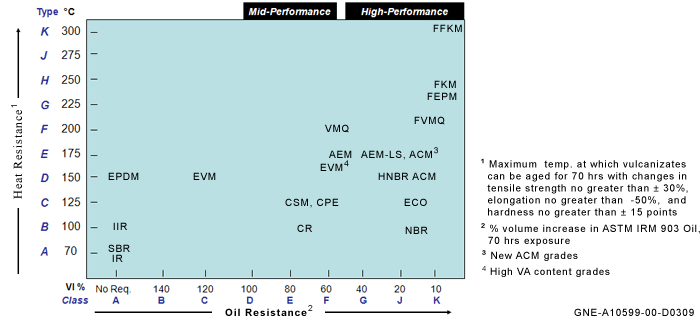
The Type/Class pair is the most information-dense position in the callout. Type is determined by heat aging performance — specifically, the maximum allowable change in tensile strength, elongation, and hardness after oven aging at a specified temperature. Class is determined by volume swell in IRM 901 oil (low-aniline-point reference oil) at a specified temperature. Together they strongly imply, though do not mandate, the polymer family most likely to meet the requirements.
| Type/Class | Heat aging temp | Max oil swell | Typical polymers | Common applications |
|---|---|---|---|---|
| AA | 70°C (158°F) | No limit | Natural rubber, SBR, butyl | General-purpose, non-oil-contact applications. Rarely specified for seals. |
| BA | 100°C (212°F) | No limit | EPDM, butyl | Weather seals, coolant hose, HVAC gaskets — oil resistance not required. |
| BC | 100°C (212°F) | Max 80% swell | Neoprene (CR), SBR blends | Moderate oil-contact outdoor applications; HVAC, marine, electrical enclosures. |
| BE | 100°C (212°F) | Max 30% swell | Neoprene (CR) | Better oil resistance than BC. Automotive weatherstrip with moderate oil splash. |
| BF | 100°C (212°F) | Max 60% swell | Neoprene (CR), NBR blends | General oil-service applications. Common neoprene gasket designation. |
| BG | 100°C (212°F) | Max 40% swell | NBR (nitrile), neoprene | Hydraulic system gaskets, industrial oil-service seals. Very widely specified. |
| CH | 125°C (257°F) | Max 20% swell | NBR (premium), HNBR | Higher-temperature oil service. Automotive transmission and powertrain seals. |
| DF | 150°C (302°F) | Max 60% swell | Silicone (VMQ), acrylic (ACM) | High-temp non-oil-contact seals. Oven equipment, exhaust-adjacent gaskets. |
| EE | 150°C (302°F) | Max 30% swell | HNBR, acrylic (ACM) | Hot oil service — turbocharger seals, transmission components, hot hydraulics. |
| EF | 150°C (302°F) | Max 60% swell | Silicone (VMQ), acrylic (ACM) | Elevated temperature with moderate oil tolerance. Engine bay environmental seals. |
| HK | 200°C (392°F) | Max 20% swell | FKM (fluoroelastomer) | High-temp chemical and fuel resistance. Fuel injectors, exhaust, chemical processing. |
| KK | 225°C (437°F) | Max 20% swell | FKM (high-fluorine grades) | Extreme temperature service. Aerospace, semiconductor, and high-performance automotive. |
Grade Number: What It Controls and Why Grade 1 Is Almost Never Enough
The grade number (1 through 7 in most applications) controls how many suffix requirements can be added to the callout and which test tables apply. Grade 1 means basic requirements only — the compound must meet tensile strength, elongation at break, and hardness requirements for its Type/Class, with no additional suffix tests. No heat aging. No oil immersion. No compression set.
For any sealing application, Grade 1 is almost always insufficient. A Grade 1 callout tells you the compound is hard enough and strong enough at the point of manufacture. It says nothing about whether it will maintain those properties after 70 hours at operating temperature, whether it will swell in your process fluid, or whether it will recover from compression after being torqued into a joint. Grades 2 and above unlock the suffix requirements that control these behaviors.
Most automotive and industrial seal specifications use Grade 2, which permits the most commonly needed suffix tests: heat aging (A), compression set (B), fluid immersion (C, D, E), ozone resistance (F), low temperature (G), tear strength (K), and staining (H). Grade 3 and above are used when the testing protocol requires elevated temperatures or extended durations beyond what Grade 2 tables allow.
Hardness and Tensile Strength: Reading the Three-Digit Block
The three digits immediately following the Type/Class designation encode hardness and tensile strength in a compact format that trips up engineers encountering D2000 for the first time.
14 = minimum tensile strength of 14 MPa (metric callout, indicated by leading M)
In English units without M: BG 220 = 70 Shore A, minimum 2000 psi tensile strength (only first two digits of psi value shown)
The hardness digit always represents the tens place of the Shore A value. 6 = 60 Shore A, 7 = 70 Shore A, 8 = 80 Shore A. The tolerance is always ±5 points unless overridden by a Z callout. Non-standard durometers (65, 75, 45) require a Z suffix: Z1 = 75 durometer (±5).
70 Shore A is by far the most common hardness specification for static sealing applications. It is a reasonable default that represents decades of compounded experience across millions of seal applications. For most industrial gaskets, o-rings, and static seals, specifying 70 Shore A without deviation is correct. The Shore A durometer post on this site covers when and why to deviate from 70.
Suffix Requirements: What Each Letter Controls and the “Alphabet Soup” Problem
Suffixes are the most powerful — and most misused — part of the D2000 callout. Each suffix adds a specific performance test requirement that the compound must pass. The suffix consists of a letter designating the test type and a two-digit number encoding the temperature and duration at which the test is run.
Suffix Letter Reference
| Suffix | Test type | What it controls | When to include |
|---|---|---|---|
| A | Heat aging resistance | Change in tensile, elongation, and hardness after oven aging at specified temperature and duration. The most commonly required suffix for sealing applications. | Always. Heat aging is the baseline indicator of compound thermal stability and long-term property retention. Omitting it removes the most important long-term performance check. |
| B | Compression set resistance | Maximum allowable permanent deformation after sustained compression at specified temperature. Directly predicts whether the seal will maintain contact force over service life. | Always for sealing applications. Compression set is the primary failure mechanism for static seals. Specifying durometer without a compression set suffix leaves the most critical long-term sealing variable uncontrolled. |
| C | Fluid immersion (IRM 901 oil) | Volume swell, tensile change, and hardness change after immersion in reference oil. Low-aniline-point aromatic reference oil — more aggressive than most service oils. | For petroleum oil-contact applications where the Type/Class oil swell limit is not sufficient for your specific fluid. The Class letter already sets a basic oil resistance level; C suffix adds a specific tested requirement. |
| D | Fluid immersion (IRM 902 oil) | Same as C but in IRM 902, a medium-aniline-point reference oil representing moderate petroleum service. | For applications involving medium-aromatic petroleum fluids when IRM 901 (C) is too aggressive for the actual service fluid. |
| E | Fluid immersion (IRM 903 oil) | Same as C/D but in IRM 903, high-aniline-point paraffinic oil. Also used with suffix “O” designation for specific service fluids not covered by standard reference oils. | For paraffinic oil environments (most mineral gear oils, transformer oils). EO suffix with a fluid number specifies immersion in a named service fluid rather than reference oil. |
| F | Ozone resistance | No cracking after ozone chamber exposure at specified concentration and duration. Critical for polymers susceptible to ozone attack (NBR, natural rubber, SBR). | For outdoor or weathering applications using NBR or other ozone-susceptible polymers. EPDM and FKM have inherent ozone resistance and rarely require F suffix testing — it is redundant for those polymers. |
| G | Low temperature brittleness | No cracking or failure in low-temperature brittleness test at specified temperature. A pass/fail test, not a continuous measurement. | For applications with low-temperature service requirements. Specify the test temperature matching the lowest expected service temperature, not an arbitrary cold-climate value. |
| H | Staining resistance | No staining of a mating painted surface. Only relevant for applications where the rubber contacts painted or coated surfaces. | Automotive body seals, painted panel gaskets, and similar applications. Unnecessary for fluid system seals or industrial gaskets with no surface staining concern. |
| K | Tear resistance | Minimum tear strength per ASTM D624. Important for parts that are handled repeatedly, installed over rough hardware, or subjected to mechanical stress during assembly. | For thin gaskets, complex profiles that are stretched during installation, or applications where tearing during assembly is a known failure mode. Not required for standard flat gaskets in straightforward bolted joints. |
| Z | Special requirements | Engineer-defined requirements beyond the standard tables: specific polymer designation, color, FDA compliance, alternative durometer, named fluid compatibility, cleanroom requirements. | When any requirement outside the standard D2000 tables is needed. Z callouts are numbered sequentially (Z1, Z2, Z3…) and each must be fully defined in the drawing or specification notes. |
Reading Suffix Numbers: Temperature and Duration Encoding
The two-digit number following each suffix letter encodes both the test temperature and duration from a lookup table in the D2000 standard. The encoding is not intuitive — you need the table to decode it. The most common combinations for standard sealing applications:
| Suffix number | Temperature | Duration | Common use |
|---|---|---|---|
| A11 | 70°C (158°F) | 70 hours | Low-temp heat aging for general-purpose compounds (BA, BC type) |
| A14 | 100°C (212°F) | 70 hours | Standard heat aging for NBR, neoprene (BG, CH type). The most common A suffix. |
| A19 | 150°C (302°F) | 70 hours | Elevated heat aging for HNBR, acrylic, high-temp compounds (EE, EF type) |
| A1-13 | 125°C (257°F) | 70 hours | Intermediate heat aging for CH type compounds |
| B14 | 100°C (212°F) | 22 hours | Standard compression set test for NBR and neoprene. Paired with A14 in most BG callouts. |
| B38 | 200°C (392°F) | 22 hours | High-temperature compression set for FKM (HK type) |
| EO34 | 100°C (212°F) | 70 hours | Fluid immersion in IRM 903 oil. Standard oil resistance suffix for BG NBR compounds. |
| F17 | 38°C (100°F) | 96 hours | Ozone resistance. Required for NBR in outdoor or weathering service. |
The Alphabet Soup Problem: Over-Specifying Suffixes
The most common D2000 specification error is not misreading the callout — it is adding suffix requirements that the application does not actually need. Every suffix beyond what the application demands adds compound testing cost, may require the compounder to formulate a special compound rather than drawing from their standard inventory, and extends lead time. In competitive sourcing situations, an over-specified callout can unnecessarily restrict the number of compounds that qualify and drive up piece price.
The minimum sufficient callout for most static industrial sealing applications in oil service is: Type/Class + Grade 2 + A (heat aging at service temperature) + B (compression set at service temperature) + E or EO (oil immersion in appropriate reference fluid). Adding ozone (F) is justified for outdoor applications or NBR in ozone-present environments. Adding low temperature (G) is justified when cold-start or low-ambient sealing is required. Everything else requires a specific engineering justification from the actual service conditions.
Four Complete Callout Examples Decoded
Example 1 — Standard NBR hydraulic seal
A14 = heat aged 70h at 100°C | B14 = compression set 22h at 100°C | EO34 = immersed in IRM 903 oil 70h at 100°C
This is the most common callout for general-purpose NBR seals and gaskets in industrial hydraulic and lubrication systems. It covers the three core tests that determine whether a nitrile compound will hold up in oil service over temperature.
Example 2 — FKM high-temperature fuel seal
A1-19 = heat aged 70h at 175°C | B38 = compression set 22h at 200°C | EO74 = oil immersion at elevated temp | F17 = ozone resistance
Standard FKM seal callout for automotive fuel system and high-temperature applications. The Grade 4 designation enables the high-temperature test conditions that Grade 2 tables do not include. HK type strongly implies FKM is required — no common alternative polymer can simultaneously meet 200°C heat aging and 20% maximum oil swell.
Example 3 — EPDM water system gasket
A14 = heat aged 70h at 100°C | B14 = compression set 22h at 100°C | Z1 = compound must meet FDA 21 CFR 177.2600 food-contact compliance
Water and steam system gasket specification using EPDM. Note the absence of oil swell suffix — BA class imposes no oil resistance requirement because the service is aqueous, not petroleum. The Z1 callout adds FDA food-contact compliance as a requirement the standard D2000 tables cannot express. 60 Shore A is specified rather than the 70 default to improve conformance to irregular pipe flange surfaces at modest bolt loads.
Example 4 — Neoprene outdoor enclosure gasket with flame resistance
A14 = heat aged 70h at 100°C | B14 = compression set 22h at 100°C | F17 = ozone resistance 96h | Z1 = UL 94 V-2 flame rating
Outdoor electrical enclosure gasket specification for neoprene. F17 (ozone) is appropriate — unlike NBR, neoprene genuinely needs the ozone suffix validated because outdoor UV and ozone exposure is the primary degradation mode for enclosure gaskets. The Z1 UL 94 V-2 callout addresses neoprene’s inherent flame resistance in a way the standard D2000 tables cannot — it specifies the third-party flammability certification rather than just the material property.
How to Construct a D2000 Callout for a New Application
Use this sequence when writing a D2000 designation from scratch:
- Step 1 — Determine the operating temperature. The highest continuous service temperature at the seal interface drives the Type selection. Below 100°C: B-type. 100–125°C: B or C-type. 125–150°C: C or D-type. Above 150°C: D, E, H, or K-type.
- Step 2 — Determine the fluid exposure. No oil contact: AA or BA class. Moderate petroleum contact: BC or BF. Significant oil immersion: BG or CH. High-temp oil: EE. Aggressive chemicals at high temperature: HK (FKM).
- Step 3 — Select Type/Class from the intersection. The D2000 tables organize Type/Class combinations by these two parameters. Choose the combination that matches both requirements. If you need 125°C service with max 20% oil swell, CH is the correct Type/Class.
- Step 4 — Set hardness. 70 Shore A (digit 7) for most static sealing. 60 Shore A (digit 6) for lower-bolt-load gaskets or irregular surfaces. 80 Shore A (digit 8) for high-pressure extrusion resistance. Deviations from 70 require a specific engineering reason — use Z callout for non-standard values like 65 or 75.
- Step 5 — Set tensile strength. Use the minimum value from the D2000 Type/Class table for your selection, or increase if the application loading demands higher tensile. Don’t over-specify — requiring 20 MPa when the table minimum is 10 MPa restricts compound options without benefit unless the part is mechanically loaded in tension.
- Step 6 — Add only the suffixes the application actually needs. Always include A (heat aging) and B (compression set) at the service temperature. Add E or EO (oil immersion) for petroleum-wetted service. Add F (ozone) for outdoor NBR applications. Add G (low temperature) if cold-start sealing is required. Stop there unless another service condition specifically justifies an additional suffix.
- Step 7 — Add Z callouts for requirements outside the tables. Polymer specification, FDA compliance, UL 94 rating, color, specific fluid compatibility not covered by standard reference oils, non-standard durometer. Each Z callout must be fully defined — “Z1 = polymer: NBR” or “Z1 = 75 durometer ±5” — not left as an open reference.
- Step 8 — Set the grade. Grade 2 is sufficient for most industrial and automotive sealing applications. Use higher grades only when the test conditions required by your suffixes exceed Grade 2 table limits.
Three Specification Errors Engineers Repeat
1. Specifying the polymer instead of the D2000 callout
Drawing notes that read “Material: Nitrile 70 Shore A” without a D2000 callout give the manufacturer no performance requirements to meet beyond hardness. Two compounds both described as “70 Shore A nitrile” can have dramatically different compression set behavior, heat aging performance, and oil resistance depending on their formulation. A D2000 callout converts a generic material description into a measurable performance specification.
2. Assuming Type/Class guarantees the polymer
BG Type/Class strongly implies NBR, but does not require it. A compounder who can formulate a neoprene compound that passes BG testing can legitimately supply it to a BG callout. If the polymer is critical — for regulatory traceability, known fluid compatibility data, or historical performance records — lock it with a Z callout. If it is not critical, allow the compounder the flexibility to meet the performance requirements with their best available formulation.
3. Copying a callout from a similar application without reviewing the suffix logic
The fastest way to produce an over-specified drawing is to copy a callout from a part that worked in a different application and paste it onto a new design. The original callout may have included ozone resistance for an outdoor application that your indoor hydraulic seal does not need, or low-temperature testing for a climate the new installation never experiences. Review each suffix against the actual service conditions of the new application before reusing any callout.
Need a D2000 compound for a sealing application?
Wayne Rubber manufactures custom rubber seals, gaskets, and o-rings to ASTM D2000 callouts across all major elastomer families. Share your callout and application details and we will confirm compound availability and quote.