
Urethane Rubber
Polyurethane Elastomer | AU (Polyester) | EU (Polyether) | ASTM D1418: AU/EU
Urethane rubber occupies a unique position among elastomers: it delivers the highest abrasion resistance and highest tensile strength of any commercially available rubber material, in a durometer range that spans from very soft sealing compounds through rigid load-bearing grades. Where conventional rubber would wear through, cut, or tear, urethane continues to perform.
Wayne Rubber manufactures custom urethane seals, bumpers, bushings, rollers, diaphragms, and wear components in Wixom, Michigan. Urethane’s specific vulnerabilities (hydrolysis above approximately 140°F in wet service, and attack by strong bases and oxidizing acids) are real constraints that must be understood before specification. This page covers the backbone chemistry, AU vs. EU grade selection, processing forms, and the complete picture of what urethane can and cannot do.
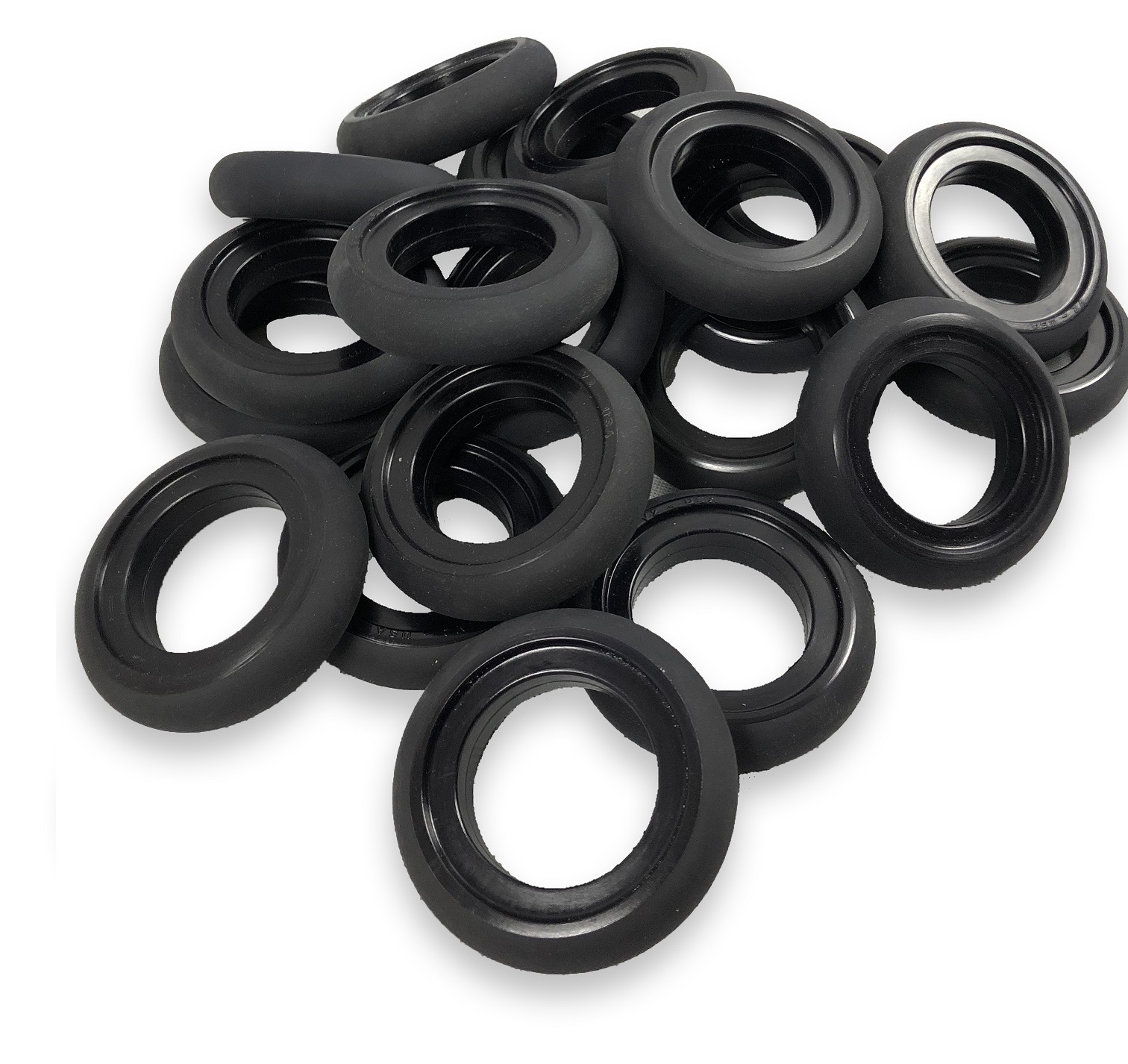
Hard Segment / Soft Segment: Why Urethane Combines Rubber and Plastic Properties
Every conventional elastomer is either rubber-like or plastic-like. Urethane is structurally both, simultaneously; the reason is a chemical architecture called hard segment / soft segment phase separation that no other common elastomer replicates.
A urethane polymer consists of two chemically distinct regions in the same chain: soft segments formed from long-chain polyols (polyester or polyether), which are mobile, flexible, and low-melting; and hard segments formed from the isocyanate and chain extender reaction products, which are stiff, polar, and high-melting. These two segment types are chemically incompatible enough that they separate into distinct microscopic domains within the solid polymer: soft segment domains that provide rubber-like elasticity and flexibility, surrounded by hard segment domains that act as physical crosslinks and reinforcing fillers.
The hard segment domains contribute tensile strength and rigidity that conventional rubber compounds cannot achieve without heavy filler loading. The soft segment domains contribute the elasticity and flexibility. The ratio of hard to soft segments, along with the specific polyol and isocyanate chemistry, controls where the material falls between rubber-like 20 Shore A (mostly soft segments) and plastic-like 85 Shore D (mostly hard segments). This tunability across the full rubber-to-plastic range from a single polymer family is unique to urethane among commercial elastomers.
The abrasion resistance consequence of this architecture is significant. Hard segment domains resist surface abrasion by providing localized high-modulus reinforcement throughout the material. Under abrasive loading, the hard segments bear the contact stress while the soft segments maintain the elasticity that allows the material to recover rather than fracture. No conventional rubber (not even heavily carbon-black-filled SBR or natural rubber) approaches the abrasion resistance of a well-formulated urethane compound.
Polyester (AU) vs. Polyether (EU): The Primary Selection Decision
The soft segment chemistry (whether polyester or polyether polyols are used) is the primary specification variable in urethane selection. AU and EU grades have comparable mechanical properties and hardness range, but they fail in different environments. Choosing the wrong backbone for the application’s fluid and temperature exposure produces premature hydrolytic degradation that appears identical to an overloaded or incorrectly specified compound.
- Higher tensile strength and better abrasion resistance than equivalent EU grades; the preferred backbone when maximum mechanical performance is the priority
- Good resistance to petroleum-based oils, fuels, and aliphatic hydrocarbons; the standard specification for hydraulic cylinder seals and oil-wetted wear components
- Susceptible to hydrolysis: water, steam, and humid environments above approximately 140°F (60°C) attack the ester bonds in the soft segment, causing progressive softening, loss of mechanical properties, and eventual disintegration. This is the most common AU failure mode in wet industrial applications
- Not suitable for applications with continuous water immersion above 140°F, steam contact, or high-humidity environments at elevated temperature
- Also susceptible to microbial attack in wet environments; fungal esterases can degrade polyester soft segments over time in standing water applications
- The default specification for dry or oil-wetted applications where water temperature is below 140°F
- The ether bonds in the soft segment are substantially more resistant to hydrolysis than the ester bonds in AU; EU grades can handle continuous water contact and humid environments at elevated temperature where AU would degrade
- Better low-temperature flexibility than AU grades at equivalent durometer, useful for cold-climate applications where urethane’s abrasion or load-bearing properties are needed alongside low-temperature seal integrity
- Resistance to microbial attack is better than AU in wet environments
- Slightly lower mechanical properties (tensile strength and abrasion resistance) than AU at equivalent formulation; the cost of improved hydrolysis resistance
- Lower oil resistance than AU in petroleum-based fluid service; AU is preferred where continuous mineral oil immersion is present alongside mechanical demands
- The correct specification for water-service applications (hydraulic systems using water-glycol fluid, marine equipment, food processing washdown equipment) and cold-climate outdoor applications
Urethane’s Exceptional Durometer Range
One of urethane’s most practically useful characteristics is the breadth of its hardness range. The same polymer family delivers useful parts from 20 Shore A (extremely soft, conformable) through 85 Shore D (semi-rigid, load-bearing). No other elastomer family spans this range with consistent mechanical quality at each durometer. This means a single material expertise covers applications from soft gaskets through rigid wear plates and structural bushings.
Cast, Millable, and TPU: Three Processing Routes
Urethane rubber is produced and processed by three distinct methods, each suited to different applications, volumes, and geometry requirements. The processing form affects tooling approach, lead time, compound formulation options, and what geometries are achievable.
Two-component liquid systems (polyol and isocyanate) are mixed and poured or injected into molds, then heat-cured. Cast urethane can achieve the widest range of hardnesses and the best mechanical properties of any urethane processing route. Open casting is used for large, simple shapes; reaction injection molding (RIM) for more complex enclosed geometries. Tooling cost is lower than compression molds for large parts. The standard processing route for large wear blocks, screen panels, rollers, and custom-geometry industrial wear components. Post-cure is typically required to develop full mechanical properties.
Solid urethane polymer supplied in gum form, mixed with fillers and curing agents on standard rubber mills and calendars, and compression-molded using conventional rubber tooling. Enables urethane to be processed on existing rubber manufacturing equipment without capital investment in casting or injection molding systems. Mechanical properties are somewhat lower than cast urethane at equivalent durometer. The most practical route for manufacturers (including Wayne Rubber) already equipped for compression molding, who want to offer urethane compounds alongside conventional rubber grades for wear-resistant seal and gasket applications.
Thermoplastic polyurethane is a linear polymer (not crosslinked) that can be injection-molded, extruded, and reprocessed like a thermoplastic at elevated temperatures. TPU provides most of urethane’s mechanical advantages with the processing economics of injection molding at high volumes. Trade-off is slightly lower heat resistance than thermoset cast urethane and poorer compression set in sustained static load applications. The preferred form for high-volume injection-molded components: automotive body seals, cable jacketing, footwear components, and precision seal profiles where injection molding cycle times and dimensional consistency are essential.
Urethane Chemical Resistance: Strengths and Hard Limits
| Fluid / Environment | Resistance | Notes |
|---|---|---|
| Petroleum Oils (AU grades) | Good to Excellent | Polyester AU urethane has good resistance to mineral oils, hydraulic fluids, and fuels, substantially better than natural rubber or SBR. The standard specification for urethane hydraulic seals operating in mineral oil service. EU grades have lower oil resistance and are not preferred for continuous petroleum fluid immersion. |
| Water (cold and ambient) | Good (EU) / Fair (AU) | EU polyether grades have good cold and ambient water resistance. AU polyester grades are adequate at room temperature for short-term contact but degrade with long-term water immersion. For water-service applications, always specify EU grades. Neither AU nor EU is suitable for steam or water above 140°F. |
| Hot Water and Steam (above 140°F) | Poor: Both Grades | This is urethane’s primary limitation in industrial sealing. Hot water and steam hydrolyze both AU and EU grades, with AU degrading faster. If the application involves water above 140°F, steam, or hot aqueous cleaning cycles, urethane is not suitable. EPDM is the correct specification for steam; EU urethane may be evaluated for water service up to approximately 140°F but with expected lifetime reduction relative to dry service. |
| Ozone and UV | Good | Urethane has good ozone and UV resistance relative to natural rubber, SBR, and nitrile. Suitable for outdoor applications where abrasion resistance is the primary requirement. Long-term UV exposure may cause surface yellowing in aliphatic polyurethane grades; aromatic polyurethane grades discolor more rapidly under UV but maintain mechanical properties. |
| Aliphatic Hydrocarbons (fuels, solvents) | Good (AU) | Good resistance to aliphatic hydrocarbons in AU grades. Adequate for fuel system gasket and seal applications where mineral-base petroleum contact is present. Verify specific fuel grade and aromatic content for demanding fuel applications. |
| Strong Bases (NaOH, KOH) | Poor | Strong alkalis hydrolyze urethane’s urethane bonds, causing degradation regardless of whether AU or EU backbone is used. Urethane is not suitable for caustic service. EPDM is appropriate for alkaline aqueous environments. This is a less well-known urethane limitation that can cause unexpected failures in cleaning agent environments using sodium hydroxide-based CIP chemicals. |
| Concentrated Acids | Poor | Concentrated mineral acids attack urethane bonds. Not suitable for concentrated acid service. Moderate dilute acid exposure at room temperature may be acceptable depending on the specific grade and concentration; verify against the Chemical Resistance Guide. |
| Ketones and Esters | Poor | Ketones and esters swell and degrade urethane. Not suitable for ketone or ester solvent contact. |
| Abrasion (dry sliding) | Best of Any Elastomer | This is urethane’s defining engineering advantage. Abrasion resistance of AU urethane in dry sliding contact against abrasive materials (sand, gravel, aggregate, metal surfaces) is typically 3 to 10 times better than natural rubber or SBR compounds at equivalent hardness. This property justifies urethane’s use in applications where any other elastomer would wear through within weeks or months of service. |
When Urethane Is and Is Not the Right Specification
Specify Urethane When:
Abrasion resistance is the primary failure mode and conventional rubber (natural rubber, SBR, neoprene) is wearing through unacceptably quickly. Chute liners, conveyor system wear components, scraper blades, mining screen panels, and agricultural equipment wear parts are all applications where urethane’s abrasion advantage over rubber justifies its higher compound cost.
High tensile strength and tear resistance are required across a broad durometer range, including mid-range hardnesses (70-80 Shore A) where conventional rubber compounds are relatively weak unless heavily filled. Urethane provides higher mechanical strength at 70 Shore A than most rubber compounds of the same hardness.
A single component must span both rubber-like (sealing) and plastic-like (structural) behavior. Urethane’s broad hardness range and the ability to vary stiffness locally in a molded part through geometry or dual-durometer design makes it uniquely suited for components that must conform to seal a surface while also bearing structural load.
Metal replacement in moderate-load applications is the design goal. Hard urethane grades (65-85 Shore D) replace steel and aluminum in components like sprockets, wear plates, and guide wheels where corrosion resistance, weight reduction, and noise attenuation are priorities alongside load-bearing capacity.
Do Not Specify Urethane When:
The application involves sustained water contact above 140°F, steam, or caustic cleaning agents. Hydrolysis will degrade AU grades and eventually EU grades under these conditions. EPDM is the correct specification for steam and hot aqueous service. This is the most common urethane specification error in food processing and pharmaceutical equipment where CIP cleaning temperatures or steam sterilization are part of the process.
The application involves strong bases (caustic soda, amines at high concentration) or concentrated acids. Urethane bonds are attacked by both. Specify EPDM for alkaline aqueous service or FKM for acid and chemical resistance at elevated temperatures.
Continuous service temperature above 220°F is required. Urethane’s upper temperature limit is lower than EPDM (for water service) or silicone and FKM (for dry heat). At sustained temperatures above 220°F, urethane softens, loses mechanical properties, and may creep under load.
Ketone-based cleaning agents or process solvents will contact the part. Urethane does not resist ketones regardless of backbone chemistry.
Urethane Rubber Applications
Urethane Rubber Products from Wayne Rubber
Wayne Rubber manufactures custom urethane components in AU (polyester) and EU (polyether) grades via compression molding of millable gum compounds. Specify the required durometer, backbone type (AU or EU), and service environment when requesting a quote.
Request Custom Urethane Parts from Wayne Rubber
Provide your part drawing, required durometer, service fluid and temperature, and whether abrasion resistance, sealing, or load-bearing is the primary design criterion. Wayne Rubber will recommend AU or EU grade and quote.