
Custom Rubber Sleeves
The term “rubber sleeve” covers four mechanically distinct product types that share a cylindrical form but serve completely different functions. A shaft sleeve reduces wear and absorbs vibration between a rotating shaft and its housing; its ID tolerance and radial stiffness are the critical parameters. A pipe connection sleeve joins two pipe ends with flexible sealing and accommodates misalignment; its end geometry and hoop stress under internal pressure are the design drivers. A protective sleeve shields a cable, rod, or machined surface from abrasion and environmental attack; its wall thickness and compound hardness against the abrasive surface determine service life. A grip sleeve provides a textured, non-slip surface for a handle or tool; its surface friction coefficient and tear resistance at the grip pattern determine performance. Specifying the right sleeve means knowing which of these four problems you are actually solving.
Wayne Rubber manufactures custom rubber sleeves for shaft protection, pipe connection, abrasion shielding, and grip applications in Wixom, Michigan. Compression molded, mandrel-wrapped, and extruded construction in EPDM, NBR, neoprene, silicone, natural rubber, HNBR, and polyurethane across any required ID, OD, and length.
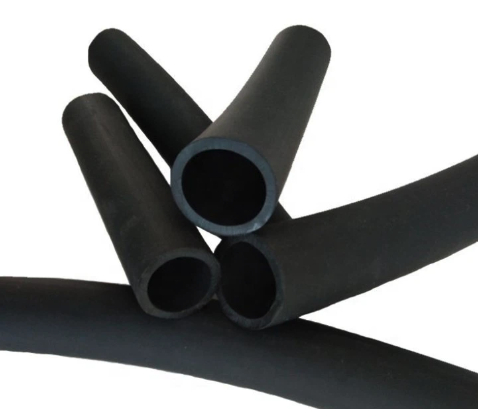
Rubber Sleeve Functions: Four Distinct Design Problems
Each sleeve type has different critical dimensions, different compound requirements, and different failure modes. Understanding which type you need is the starting point for an accurate specification.
A rubber sleeve installed between a rotating or reciprocating shaft and its surrounding housing or bearing, providing vibration isolation, wear absorption, and a replaceable wear surface that protects the shaft from direct contact damage. Critical design parameters: the ID must be held to close tolerance to achieve the correct interference or clearance fit on the shaft; the radial stiffness (a function of wall thickness and durometer) determines the vibration isolation effectiveness; the compound must resist the lubricant or fluid in the bearing cavity. Common compounds: NBR for mineral oil lubrication; HNBR for high-temperature oil service; EPDM for water-lubricated applications; polyurethane for high-load dry applications where abrasion resistance is needed. Key failure mode: wear through the sleeve wall to the shaft, accelerated by incorrect clearance or incompatible lubricant chemistry.
A rubber sleeve that joins two pipe or tube ends, absorbing vibration and thermal movement, accommodating axial and angular misalignment, and sealing against internal fluid pressure. The sleeve is clamped at each end over the pipes using band clamps or integrated bead retainers. Critical design parameters: the ID must match the pipe OD with minimal clearance for a reliable clamp seal; the wall thickness and compound modulus determine how much angular misalignment the sleeve can absorb without kinking; the compound must resist the fluid inside the pipes. Common compounds: EPDM for water, coolant, and steam; NBR for petroleum-based fluids; silicone for high-temperature air and gas; neoprene for general service with moderate temperature range. Key failure mode: sleeve kinking at the clamp edge under repeated flexing, caused by insufficient wall thickness or excessive misalignment relative to sleeve length.
A rubber sleeve that slides or bonds over a cable, rod, pipe, or machined surface to protect it from abrasion, impact, UV, chemical attack, or contamination. The sleeve may be a snug stretch-fit, a loose slip-over, or bonded in place. Critical design parameters: the wall thickness relative to the abrasive load determines how long the sleeve lasts before wearing through to the protected component; the ID clearance determines ease of installation and whether the sleeve stays in place without bonding; the compound determines resistance to the specific abrasive environment (dry particle abrasion, wet slurry, UV and ozone, chemical splash). Common compounds: natural rubber for dry abrasion and high impact resilience; polyurethane for severe abrasion with high load; EPDM for outdoor UV, ozone, and weathering; neoprene for moderate oil splash alongside weather resistance. Key failure mode: abrasion wear-through, which is solved by increasing wall thickness, increasing durometer, or switching to a harder-wearing compound family.
A rubber sleeve that fits over a tool handle, equipment grip, or hand-contact surface to improve tactile grip, cushion vibration, and protect the user’s hand from heat, sharp edges, or chemical contact on the underlying surface. Critical design parameters: the ID must be snug enough to prevent rotation and migration without being too tight to install by hand; the surface texture (ribbed, dimpled, stippled, or smooth) determines grip coefficient; the durometer must be soft enough for comfort without being so soft that the sleeve tears at the edge under regular gripping forces. Common compounds: natural rubber for highest grip coefficient and tear resistance; EPDM for outdoor tools with UV exposure; silicone for high-temperature applications and medical/food equipment handles requiring cleanability; neoprene for tools in environments with moderate chemical and oil contact. Key failure mode: tearing at the sleeve end or in the grip pattern under repeated high-force gripping, solved by increasing wall thickness at the end and ensuring the grip geometry does not create stress concentration at thin sections.
Three Manufacturing Processes for Rubber Sleeves
The manufacturing process for a rubber sleeve determines the achievable tolerances, the minimum and maximum size range, the complexity of cross-section geometry possible, and the tooling investment required. Wayne Rubber selects the correct process for each sleeve application during engineering review.
Uncured rubber compound is placed in a cavity tool that defines the sleeve’s inner and outer profile, then cured under heat and pressure. Produces sleeves with precise ID and OD dimensions, complex cross-section profiles (flanges, grooves, ribs, tapers), and consistent wall thickness across the lot. Best for: shaft and bearing sleeves requiring tight ID tolerance; grip sleeves with complex surface texture molded in; pipe connection sleeves with integrated bead retainers for clamp seats. Limitation: practical for lengths up to approximately 12-16 inches with conventional tools; very long sleeves require multiple mold shots or mandrel wrapping. Tooling cost is moderate; production tolerance is RMA Class 2 or better depending on geometry.
Uncured rubber sheet or strip is wrapped onto a mandrel (a tool shaped like the desired bore), vulcanized, and then the mandrel is removed. The process produces seamless-bore sleeves with accurate ID (determined by the mandrel) without hard tooling for the outer profile. Best for: long sleeves beyond the range of compression molding tools; protective sleeves for large-diameter cables, pipes, and rods where tooling cost for a full cavity mold would be prohibitive; oilfield centralizer sleeves and long industrial protective sleeves. Advantage: no tooling cost for the OD; OD is determined by the number of wraps. Limitation: the outer surface has a wrap seam; complex outer profiles (ribs, flanges) cannot be achieved; outer diameter control is less precise than compression molding. Compounds: mandrel wrapping is compatible with all elastomers that can be calendered to sheet.
Rubber compound is continuously extruded through a die that defines the cross-section profile of the sleeve, then vulcanized in a continuous line. The process produces sleeves of any length from a continuous tube that is cut to specification. Best for: simple circular cross-section sleeves in high volumes where consistent ID and OD is required but complex features are not needed; protective tubing for cables and hose; grip sleeving supplied in bulk roll form for field cutting. Limitation: limited to uniform cross-section profiles that can be formed through a die; features such as flanges, bead retainers, and tapers require secondary operations. Tightest tolerance on ID and OD is less precise than compression molding for small-diameter sleeves. Compounds: not all elastomers extrude consistently; EPDM, NBR, neoprene, and silicone are the best-suited compounds for extrusion processes.
Rubber Sleeve Compound Selection by Application
| Compound | Sleeve Applications | Key Properties | Avoid When |
|---|---|---|---|
| EPDM | Outdoor protective sleeves on cables and conduit; pipe connection sleeves for water, coolant, and steam; grip sleeves on outdoor tools; marine and agricultural equipment sleeves in sustained UV exposure | Best outdoor UV, ozone, and weather aging of any standard elastomer; excellent water and steam resistance; long service life on outdoor-deployed protective sleeves; good low-temperature flexibility for cold-climate field tools | Petroleum oil, hydraulic fluid, or fuel contact; sleeve applications on equipment in machine shop or manufacturing environments where oil splash is present; high-temperature service above 300°F (silicone required) |
| NBR | Shaft sleeves in mineral oil-lubricated machinery; bearing sleeves on motors and pumps with oil bath lubrication; pipe connection sleeves for petroleum lines; protective sleeves in machine shop environments with oil splash | Standard petroleum oil resistance for bearing and shaft sleeve applications; good compression set resistance for shaft sleeves under sustained radial load; standard compound for oil-wetted mechanical sleeve applications below 250°F | Outdoor UV and ozone exposure without protection; water system pipe sleeves (EPDM better); high-temperature oil above 250°F service (HNBR required) |
| HNBR | High-temperature shaft and bearing sleeves on motors, compressors, and high-output machinery where oil temperatures exceed NBR’s 250°F limit; bearing sleeves in underhood automotive applications with hot oil exposure; sleeve applications in ozone-exposed environments alongside oil contact | Hot oil resistance to 300°F combined with ozone resistance; the correct upgrade from NBR for high-temperature mechanical sleeve applications; better compression set resistance than NBR at elevated temperatures; extended service life in applications that exhaust NBR sleeves through hot-oil hardening | Cost-sensitive applications where NBR’s temperature limit is not exceeded; water system and outdoor UV sleeves where EPDM is more economical and appropriate |
| Silicone | High-temperature air and exhaust duct connection sleeves; grip sleeves on medical and food processing equipment handles requiring FDA compliance and autoclave-compatible cleaning; protective sleeves near engine and exhaust heat sources; high-temperature sensor cable protection sleeves | Widest temperature range for sleeve applications requiring service above 300°F; FDA and USP Class VI grades for medical and food equipment grip sleeves; good UV resistance for outdoor service; low compression set for flexible connector sleeves that must cycle repeatedly without kinking | Petroleum oil contact (silicone swells in oil); high-abrasion applications where polyurethane or natural rubber provides better wear resistance; applications requiring the highest grip coefficient (natural rubber grips harder surfaces better) |
| Neoprene | General-purpose pipe connection sleeves in industrial environments with moderate oil splash; protective sleeves on equipment with mixed oil and weather exposure; grip sleeves on tools in automotive and marine environments; flexible coupling sleeves on commercial HVAC and refrigeration equipment | Balanced moderate oil, UV, and ozone resistance for industrial sleeve applications where the environment cannot be precisely characterized; good dynamic fatigue resistance for pipe connection sleeves that cycle under vibration; moderate cost for high-volume industrial sleeves | Sustained outdoor UV service over 10 years (EPDM outlasts neoprene significantly); high-temperature service above 250°F; aggressive chemical or petroleum immersion (FKM or NBR required) |
| Natural Rubber | High-grip handle sleeves on hand tools, sports equipment, and industrial handles requiring maximum tactile grip; protective sleeves in dry abrasion applications (grain handling, sand and gravel equipment); flexible coupling sleeves where dynamic resilience and fatigue life are more important than chemical resistance | Highest surface grip coefficient of any elastomer for handle sleeves; best fatigue life under repeated dynamic flexing for coupling sleeves in vibrating machinery; highest resilience for protective sleeves that must return to shape after impact; good dry abrasion resistance | Any petroleum oil or fuel contact; outdoor UV and ozone exposure; high-temperature applications; chemical process environments; any application where long-term outdoor weathering is required |
| Polyurethane | Heavy-duty protective sleeves in severe dry abrasion environments (mining chutes, aggregate conveyors, grain augers, oilfield drill pipe); shaft sleeves in high-load dry pivot applications; protective sleeves on hydraulic and pneumatic cylinders in outdoor construction and mining equipment | Highest abrasion resistance of any elastomer for protective sleeve applications; significantly longer service life than natural rubber or neoprene in severe dry-particle abrasion; high load-bearing capacity for shaft sleeves under sustained compressive loads | Hot water or steam above 140°F (use EU polyurethane grade for water-contact applications, AU grade for dry); sustained petroleum solvent contact; dynamic flexing applications where AU polyurethane can delaminate; high-elongation stretch-fit sleeve installation over large components |
Rubber Sleeve Applications by Industry
- Radiator hose connection sleeves on cooling systems
- Turbocharger intercooler pipe sleeves
- Drive shaft and axle protective sleeves
- Engine mount sleeve bushings in vibration isolators
- Cable and wiring harness protective sleeving
- Transmission and differential vent protection sleeves
- Pump shaft sleeves and bearing liner sleeves
- Flexible pipe coupling sleeves on process equipment
- Roller and conveyor shaft protective sleeves
- Hydraulic cylinder rod protective sleeves
- Fan and blower shaft sleeve isolators
- Pneumatic line flexible connector sleeves
- Duct flexible connector sleeves at equipment connections
- Chilled water and condenser water pipe coupling sleeves
- Pipe penetration protective sleeves through walls and floors
- Equipment vibration isolator sleeve inserts
- Refrigerant line protective sleeves at structural penetrations
- Hot water boiler flexible connection sleeves
- Drill pipe and sucker rod wear protection sleeves
- Aggregate chute lining sleeves in crushing plants
- Hydraulic cylinder rod abrasion sleeves on equipment
- Cable and hose bundling and protection sleeves
- Conveyor idler shaft protective sleeves
- Sluice gate shaft sealing and wear sleeves
- Propeller shaft cutless bearing sleeves
- Riser pipe flexible joint protective sleeves
- Cable penetration protective sleeves on vessel hulls
- Mooring line chafe protection sleeves
- Subsea control line protective tubing sleeves
- Dockline and fender attachment protective chafing sleeves
- Instrument handle grip sleeves on surgical tools
- Autoclave-compatible silicone grip sleeves
- Peristaltic pump tube protective sleeve liners
- Lab equipment handle and probe grip sleeves
- Diagnostic device cable protection sleeves
- FDA silicone food equipment handle grips
Also from Wayne Rubber
Request Custom Rubber Sleeves from Wayne Rubber
Provide the sleeve type (shaft, pipe connection, protective, or grip), the ID and OD required, the length, the environment (fluid, temperature, UV, abrasion level), and the quantity. Wayne Rubber will specify the compound and process and provide a quote with tooling and piece cost.