
Custom Rubber Feet
Rubber feet for OEM equipment are not the same product as rubber feet for consumer furniture. An equipment foot for an industrial control panel must resist floor cleaning solvents, maintain a stable compression height under a defined static load, and not cold-flow over years of continuous loading. An equipment foot for an outdoor generator must survive UV and ozone exposure while maintaining grip on wet concrete. A foot for a medical device cabinet must meet FDA contact material requirements. Getting these right requires specifying durometer, compound, geometry, and mounting method together, not selecting from a catalog of imported generic feet.
Wayne Rubber manufactures custom molded rubber feet for OEM equipment, medical devices, laboratory instruments, electronic enclosures, and industrial machinery from Wixom, Michigan. Natural rubber, neoprene, silicone, EPDM, and NBR in compression and injection molded geometries. Standard and threaded-stud mounting configurations available.
Rubber Foot Mounting Styles
The mounting method determines the geometry of the foot, the tooling required, and how it attaches to the equipment chassis. The four standard configurations cover the vast majority of OEM equipment applications. Custom geometries combining multiple features are also available from Wayne Rubber’s engineering team.
Flat or dome-profile molded feet with PSA (pressure-sensitive adhesive) backing applied to the mounting face. Best for: consumer electronics, medical device enclosures, laboratory equipment, and any application where drilling or fasteners are not acceptable. The adhesive system must be matched to the foot compound and the substrate material; standard acrylic PSA does not adhere reliably to silicone or EPDM without primer treatment, and does not perform on powder-coated or oily surfaces without surface preparation. Wayne Rubber specifies the correct adhesive for each compound and substrate combination.
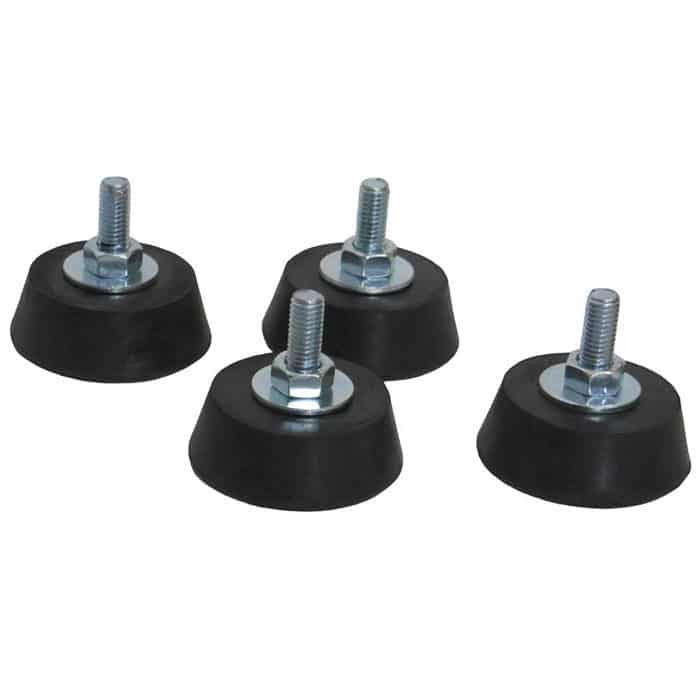
Metal threaded stud (typically 10-32, 1/4-20, or M6/M8) bonded or molded-in during the rubber foot molding process. Best for: industrial control panels, generator sets, test and measurement equipment, and machinery where the foot must be removable and adjustable. The stud-to-rubber bond requires correct adhesive selection for the elastomer and stud plating; zinc-plated studs require different primer treatment than stainless for long-term bond integrity. Stud length and thread specification are defined per customer drawing.
Tapered or profiled rubber feet designed to press into a hole or slot in the equipment chassis without adhesive or fasteners. Best for: high-volume OEM applications where installation speed is important and the foot must be retained without tooling. The interference fit must be precisely engineered: too much interference and the foot splits during installation; too little and it pulls out under load. Wayne Rubber designs the press-fit geometry and tolerance for the specific hole size and material.
Rubber foot molded directly over a metal plate, nut, or insert during the molding process, creating a permanent bonded assembly. Best for: high-load applications where a simple adhesive cannot sustain the shear force, or where the foot must be electrically conductive to the chassis. The metal insert provides load distribution and the rubber provides compliance, grip, and vibration isolation. Wayne Rubber’s rubber-to-metal bonding capability covers all insert geometries and elastomers.
Selecting Durometer for OEM Equipment Feet
Durometer (Shore A hardness) is the primary engineering variable in rubber foot selection, and it is frequently mispecified in OEM equipment programs. The correct durometer depends on the static load per foot, the required deflection under load, the vibration isolation requirement, and the surface grip requirement. These variables often pull in opposite directions; harder feet grip better on smooth surfaces but isolate vibration poorly, while softer feet isolate vibration well but may cold-flow under sustained load.
| Durometer | Static Load Behavior | Vibration Isolation | Surface Grip | Typical Applications |
|---|---|---|---|---|
| 30-40 Shore A (Soft) | High deflection under moderate loads; risk of cold-flow under sustained loads above 50 PSI contact pressure | Excellent: low dynamic stiffness; attenuates high-frequency vibration effectively | Good: high contact area with surface irregularities; best grip on rough or uneven floors | Sensitive laboratory instruments, optical benches, audio equipment, light electronics on rough concrete |
| 40-60 Shore A (Medium) | Moderate deflection; good cold-flow resistance for equipment up to 150 PSI contact pressure; the practical general-purpose range for most OEM equipment feet | Good: effective for mechanical vibration in the 15-200 Hz range typical of motors and rotating equipment | Good: sufficient compliance to conform to minor surface variations | Medical device cabinets, test and measurement racks, industrial control panels, generator sets, HVAC equipment |
| 60-70 Shore A (Medium-Hard) | Low deflection; suitable for high unit loads; minimal cold-flow risk at normal equipment weights | Fair: stiffer compound transmits more vibration; better for lateral stability than isolation | Moderate: less compliance with floor surface; better performance on smooth flat floors | Heavy industrial machinery on factory floors, outdoor generators on concrete pads, equipment requiring precise leveling without settling |
| 70-80 Shore A (Hard) | Minimal deflection; primarily functions as a bumper and surface protector rather than an isolation element; high load capacity | Poor: at this durometer, the foot transmits rather than isolates vibration | Low: hard feet have poor grip on smooth floors; prone to skidding on waxed or painted surfaces | Leveling pads on machinery with separate vibration isolation system; bumpers on equipment dollies and carts; high-load static applications |
Which Rubber Compound for Equipment Feet
Natural Rubber: the baseline for grip and vibration isolation. Natural rubber has the highest resilience of any elastomer (lowest energy loss per compression cycle), which translates to the best vibration isolation performance at equivalent durometer. It has excellent grip on most floor surfaces and excellent tear resistance at the foot edge. Limitations: poor ozone and UV resistance makes it unsuitable for outdoor or UV-exposed equipment locations, and poor oil resistance eliminates it from machine shop and manufacturing floor applications where cutting oil or hydraulic fluid may contact the foot.
Neoprene: the general-purpose OEM equipment foot compound. Neoprene provides moderate ozone, UV, and oil resistance alongside good mechanical properties and reasonable grip. It is the practical choice for indoor OEM equipment in environments with occasional oil or solvent splash (machine shop cabinets, test stands, and industrial equipment in manufacturing environments where pure natural rubber would degrade). Lower resilience than natural rubber means slightly reduced vibration isolation, but the tradeoff is appropriate for most industrial applications.
Silicone: for temperature extremes, FDA contact, and clean environments. Silicone is specified for equipment feet when operating temperature exceeds natural rubber’s or neoprene’s limits, when FDA or USP compliance is required for the foot material (medical device cabinets, food processing equipment), or when the foot will be exposed to UV and ozone in outdoor equipment installations. Silicone has lower grip than natural rubber on smooth surfaces at equivalent durometer; this can be compensated with a textured foot profile or by specifying a lower durometer with greater contact area.
EPDM: for outdoor equipment and water-exposed applications. EPDM is the correct choice for generator sets, outdoor HVAC units, and any equipment that sits outdoors in UV and ozone exposure for years. Its weather aging resistance significantly exceeds both natural rubber and neoprene. EPDM also resists the mild alkalinity of concrete floors and cleaning agents used in outdoor equipment pads. Not for applications involving petroleum oil or fuel contact.
Custom Rubber Foot Applications by Sector
- Medical device cabinet feet (silicone, FDA compliant)
- Laboratory instrument feet; low-vibration, cleanable
- Diagnostic equipment stability feet
- Analytical instrument anti-vibration isolation
- Hospital bed and equipment cart bumpers
- Control panel and cabinet feet (neoprene, oil-splash resistant)
- Machine tool isolation pads (natural rubber, 40-50A)
- Pump and compressor anti-vibration mounts
- Conveyor and material handling equipment
- Welding equipment and power supply feet
- Test and measurement equipment rack feet
- Server rack and UPS cabinet feet
- Electronic enclosure anti-vibration isolation
- Benchtop instrument stability feet
- Sensitive sensor platform isolation
- Generator set skid feet (EPDM, UV resistant)
- Outdoor HVAC unit mounting pads
- Telecom cabinet base isolation
- Solar inverter and BESS enclosure feet
- EV charging station stability feet
- Vehicle body and component mounting feet
- Transit case and flight case corner feet
- Equipment dolly and cart feet
- Battery enclosure isolation pads
- Truck body and trailer anchor pads
- Food processing equipment feet (FDA silicone or EPDM
- Commercial kitchen equipment feet
- Refrigeration unit anti-vibration mounts
- Bottling and packaging machine leveling feet
- NSF-compliant material grades available
Also from Wayne Rubber
Request Custom Rubber Feet from Wayne Rubber
Provide the equipment weight, number of feet, mounting method, operating environment (indoor, outdoor, oil-adjacent, FDA), and any dimensional constraints. Wayne Rubber will specify the compound, durometer, and geometry, and provide a quote with tooling and piece cost.