
Rubber Bumpers
Wayne Rubber manufactures custom molded rubber bumpers for impact absorption, equipment travel stops, surface protection, and noise reduction across industrial, automotive, agricultural, and commercial applications. Available in cylindrical, dome, conical, rectangular, and fully custom profiles, with threaded metal inserts, through-bolt mounting, adhesive pads, or press-fit bases molded in as needed.
A rubber bumper is an energy management component. Its performance is determined by the interaction between geometry, durometer, and the energy it must absorb or the deflection it must limit. This page covers how to match those variables to your application before requesting a quote.
Three Ways Bumpers Manage Energy
Rubber bumpers appear in three distinct functional roles, each with different requirements for stiffness, geometry, and mounting. Identifying which role the bumper serves determines the right compound and profile before any dimensions are specified.
The bumper absorbs kinetic energy from a moving mass: a door swinging closed, a machine component reaching end-of-travel, or a vehicle backing into a loading dock. Energy is converted to elastic deformation and released, ideally with low rebound so the contact is cushioned rather than bounced. Softer compounds (40 to 60 Shore A) absorb more energy per unit deflection. The bumper must be sized to absorb the full impact energy within its compression travel without bottoming out against the mounting surface.
The bumper defines the end position of a moving component: a cylinder reaching full stroke, a door at its closed position, a drawer or access panel at its limit of travel. The design priority shifts from energy absorption to consistent positional accuracy and low creep under sustained load. Harder compounds (65 to 80 Shore A) provide a more defined stop point with less deflection under static load. The bumper must resist compression set so that the stop position remains consistent over the service life.
The bumper protects adjacent surfaces from contact damage and reduces impact noise at the contact event. Common in equipment feet, machine covers, access panels, and appliance housings where the rubber prevents metal-to-metal contact and eliminates the acoustic impact signature. Non-marking compound grades are available for applications where the bumper contacts finished or coated surfaces. Medium durometer (55 to 70 Shore A) balances adequate stiffness to support the component against sufficient compliance to dampen the impact noise.
Rubber Bumper Profile Types
The bumper profile determines the force-deflection curve shape and the contact geometry at the mating surface. Simple cylindrical bumpers produce a linear load-deflection response. Conical and dome profiles produce a progressive response that gets stiffer as deflection increases, useful when a soft initial contact is wanted but full bottoming-out must be prevented.
| Profile | Load-Deflection | Best For | Notes |
|---|---|---|---|
| Cylindrical | Approximately linear | General-purpose stops, equipment feet, door buffers | Simplest to tool. Mounting options: flat base, threaded stud, through-bolt, or press-fit stem. Most common profile for industrial bumpers. |
| Dome / Hemispherical | Progressive (stiffens with deflection) | Door stops, access covers, low-load surface protection | Self-locating contact geometry reduces lateral slip under angled impact. Low tooling cost. Frequently used with adhesive-backed base for peel-and-stick installation. |
| Conical | Progressive (strongly stiffening) | End-of-travel stops requiring high energy absorption with limited bottoming | The conical shape provides the highest progressive stiffness ratio of standard profiles. Contact area increases dramatically as the cone compresses, creating a self-limiting bottoming force. Used in high-energy machine guarding applications. |
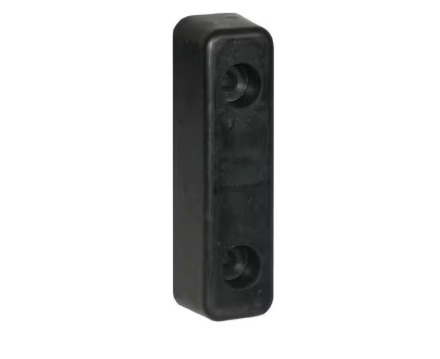
| Rectangular / Block | Linear to stiff depending on aspect ratio | Large contact area stops, loading dock bumpers, structural buffers | Large face area distributes impact load across a wider surface, reducing contact stress on both the bumper and the mating structure. Common for loading dock protection, machine guarding panels, and vehicle fleet bumper systems. |
| Threaded-Stud Bumper | Linear (cylindrical rubber body) | Adjustable stop applications, equipment with threaded mounting provisions | A metal threaded stud is bonded into the rubber base during molding. The stud threads into a tapped hole, allowing height adjustment. The rubber head contacts the mating surface. Lock-nut retains the set height against vibration. |
| Flanged / Shouldered | Variable with rubber section geometry | Panel cutout mounting, recessed installation in equipment housings | An integral flange retains the bumper in a panel cutout without adhesive or fasteners. The rubber shoulder bears against the panel rear face; the bumper body protrudes through the front face. Allows flush or near-flush installations. |
| Custom Profile | Engineered to requirement | Applications where standard profiles cannot meet load or geometric requirements | Wayne Rubber tooling and engineering support custom profiles from your dimensional drawing or performance target. Provide the required load at target deflection and Wayne Rubber will recommend the geometry and compound combination to achieve it. |
Durometer Selection for Bumpers
Bumper durometer controls how much force is required to compress the bumper to a given deflection, the rebound characteristics after impact, and long-term resistance to compression set under sustained load. The correct durometer depends on the impact energy, the required deflection at peak load, and whether the application prioritizes energy absorption or positional accuracy.
High deflection per unit load. Absorbs the most energy for a given bumper volume. Best for low-to-moderate impact loads where cushioning and noise damping are the primary goals. Higher compression set than medium or hard grades; not ideal for sustained static load or precision stop applications. Sponge grades in this range provide even softer response for very low-load environmental sealing and dust protection contacts.
The standard range for most industrial bumper applications. Balances energy absorption with positional consistency. Low enough compression set for moderate sustained-load stop applications. Neoprene and EPDM in this range are the most common compounds for general-purpose door, machine, and equipment bumpers where outdoor weathering resistance is required alongside adequate cushioning performance.
Low deflection per unit load. Defines a precise stop position with minimal creep under sustained static load. Lower energy absorption per unit volume than softer grades; the bumper does less cushioning and acts more as a hard stop with a protective face. Used where dimensional accuracy at end-of-travel is required and impact energies are low. Natural rubber and neoprene at this durometer have good compression set resistance for sustained load applications.
Mounting Configurations
The mounting method is specified during mold design and cannot be changed post-mold without tooling revision. Wayne Rubber offers the following mounting configurations, all molded in as part of the bumper:
- Flat Base (Adhesive): plain flat base for peel-and-stick installation with pressure-sensitive adhesive tape applied during fabrication
- Threaded Metal Stud: steel or stainless stud bonded into the base during molding; threads into tapped panel hole for height adjustment
- Through-Bolt: smooth bore through the bumper body accepts a bolt that clamps through both the bumper and the mounting panel
- Press-Fit Stem: cylindrical rubber or metal stem that presses into a panel hole for tool-free installation; retained by interference fit
- Recessed Screw Mount: countersunk hole in the base for a flat-head fastener that sits below the bumper contact face
- Flanged / Snap-In: integral rubber flange retains the bumper in a panel cutout without separate fasteners
- Bonded Metal Plate: steel plate bonded to the base for bolted installation on mounting surfaces not suited to stud or through-bolt configurations
- Non-Marking Compounds: available for any mounting type; required where the bumper contacts painted, coated, or finished surfaces
Bumper Materials
The most common bumper compound. Good ozone, UV, and moderate oil resistance with consistent mechanical properties over a wide temperature range. The standard material for outdoor, machine guarding, loading dock, and automotive bumper applications.
View CR data →Highest resilience and lowest hysteresis of any commodity elastomer. Best choice for high-cycle impact applications where fatigue life matters and outdoor UV/ozone exposure is not present. Higher rebound than neoprene makes NR better for applications where energy return (spring-back) is a design requirement alongside impact cushioning.
View NR data →Excellent UV, ozone, and weather resistance for outdoor bumper applications where long service life under weathering is required. Good low-temperature flexibility to approximately -65°F. Preferred over neoprene for outdoor agricultural, construction, and marine equipment bumpers in climates with high UV and temperature cycling.
View EPDM data →Oil and fuel resistant. Required when the bumper surface contacts petroleum-based fluids: machine guarding near oil-wetted equipment, floor stops in areas with oil-contaminated floors, and underhood automotive applications where splash from lubricating or hydraulic oil is expected.
View NBR data →Wide temperature range and non-marking properties for high-temperature industrial and food-processing applications. Silicone bumpers are used in oven and furnace equipment, food processing machinery, and medical device housings where operating temperatures exceed neoprene or EPDM limits.
View silicone data →Cost-effective general-purpose compounds for indoor, low-cycle bump stop and equipment foot applications where chemical exposure and UV weathering are not factors. Good mechanical properties at a lower compound cost than neoprene for high-volume applications in protected environments.
View SBR data →Rubber Bumper Applications
Bumper Manufacturing Capabilities
- Compression Molding: standard process for most bumper geometries and volume ranges
- Transfer Molding: for bumpers with integrated metal inserts, complex profiles, or precise dimensional requirements
- Injection Molding: for high-volume bumpers requiring tight shot-to-shot consistency
- Metal Insert Bonding: threaded studs, through-bolts, and base plates bonded during the molding cycle
- Non-Marking Compounds: available in neoprene, EPDM, silicone, and natural rubber for finished-surface contact
- Custom Color: color-matched compounds available for commercial and consumer applications
- Durometer Range: 40 to 90 Shore A across all listed elastomer families
- Adhesive Backing: pressure-sensitive adhesive tape applied to base for peel-and-stick installation
- Prototype to Production: development quantities through high-volume production runs
- RMA A2 Tolerances: molding tolerances per RMA A2 precision standard as baseline
Request a Quote for Custom Rubber Bumpers
Provide the bumper function (impact absorption, travel stop, or surface protection), dimensional envelope, mounting method, environment, and impact energy or load requirement. Wayne Rubber will recommend the right profile, compound, and mounting configuration.