
Rubber Boots
Wayne Rubber manufactures custom molded rubber boots for shaft protection, control linkage covers, valve stem guards, electrical connector covers, and equipment housing protection across automotive, industrial, agricultural, defense, and marine applications. Available in straight-wall, formed, tapered, and over-molded configurations, engineered to your dimensional drawing, range of motion, and environmental exposure.
Rubber boots protect the components inside them from contaminants that cause premature wear and failure. The boot must fit the protected component precisely, accommodate its range of motion without tearing, and survive the specific external environment it will face. This page covers how those requirements translate into design specifications.
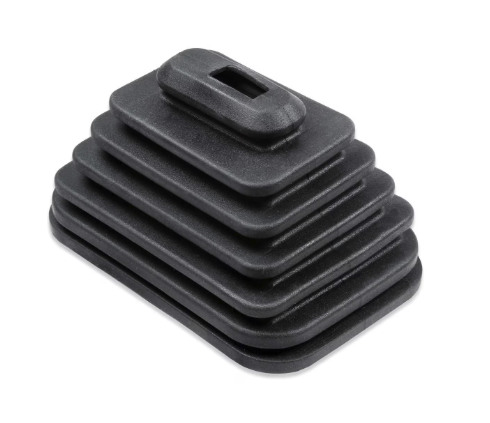
Rubber Boots vs. Rubber Bellows
Rubber boots and rubber bellows are closely related and often used interchangeably in casual language, but they are mechanically distinct. Understanding which one your application requires determines the wall geometry, the amount of motion the part can accommodate, and the tooling approach.
- Smooth or formed walls without accordion convolutions
- Accommodates motion by stretching and flexing the rubber wall
- Limited stroke ratio relative to overall boot length
- Best for limited linear travel, angular deflection, and torsional motion at a joint
- Simpler tooling than convoluted bellows for most geometries
- Common for CV joint boots, valve stem covers, connector boots, and switch boots where the range of motion is moderate and the geometry is non-linear
- Accordion convolute geometry in the wall
- Accommodates motion by folding and unfolding the convolutions
- High stroke ratio achievable, typically 3:1 or greater extended-to-collapsed
- Best for long linear stroke applications: cylinder rod boots, machine way covers, expansion joints
- More complex tooling; more design parameters to specify (number of convolutions, peak/valley geometry)
- Common for hydraulic cylinder rods, CNC machine ways, and HVAC expansion joints
Three Protection Problems Boots Solve
Rubber boots are specified to solve one or more of three distinct contamination and protection problems. Each places different requirements on the boot geometry, wall thickness, compound, and fit at the attachment points.
The boot keeps dust, dirt, water, mud, grease, and other external contaminants away from a protected component (a joint, bearing, shaft seal, or precision surface). The boot seals at both ends against the protected component and its housing, and the body flexes to accommodate joint motion without opening a leak path. The critical specification is the seal quality at the attachment points: clamp beads, integrated flanges, or press-fit features must maintain continuous contact under the full range of motion without lifting away from the mating surface.
Many rubber boots serve double duty: excluding external contaminants while simultaneously retaining lubricant (grease or oil) inside the boot to lubricate the joint it protects. CV joint boots, ball joint boots, and steering rack boots all retain the grease packed into the joint at assembly. For this function, the boot must seal positively at both ends under the internal pressure created when the joint moves and compresses the boot volume. Wall integrity is critical; any crack, pinhole, or pulled clamp allows both lubricant loss and contamination ingress simultaneously.
Control linkage boots, switch boots, and electrical connector boots protect sensitive internal components from the external environment: weather, chemical splash, UV, and physical impact. These boots typically do not need to retain lubricant; the requirement is environmental sealing at the interface between the boot and the protected component. For electrical applications, the compound must be electrically non-conductive. For chemical environments, compound selection is driven by the specific fluid or splash exposure. Tight fit at the ID opening around the control rod or connector body is the primary design challenge.
Design Parameters to Specify
A custom rubber boot is defined by the geometry of the protected component, the range of motion it must accommodate, the attachment method at both ends, and the external environment. Provide all of the following when requesting a quote to allow Wayne Rubber to evaluate the design without assumptions.
| Parameter | Notes for Specification |
|---|---|
| Large End ID | The inner diameter of the boot opening that fits over the larger housing, flange, or collar. Specify the nominal dimension and the interface type: clamp groove, press-fit, or flange. This end typically provides the primary structural anchor for the boot. |
| Small End ID | The inner diameter of the boot opening at the shaft, rod, or stem. Must seal tightly around the protected component at all positions throughout the range of motion. Specify the shaft or rod OD at this interface and whether the small end must provide a grease-retaining seal or only a dust seal. |
| Overall Length (Extended) | The boot length at maximum extension of the protected component. The rubber wall must not be stretched beyond its elastic limit at this position. For joints with angular deflection, the length changes as the joint articulates; specify the maximum extension position and the maximum deflection angle simultaneously. |
| Range of Motion | Describe the motion type: linear stroke, angular deflection, torsional rotation, or combined. For joints with angular deflection (ball joints, CV joints), specify the maximum articulation angle. The boot wall geometry and durometer must allow this motion without kinking, buckling, or lifting away from the attachment points. |
| Wall Thickness | Thinner walls flex more freely and require less force to actuate, but have lower tear resistance and shorter fatigue life in high-cycle applications. Thicker walls improve durability and retain grease pressure better but may kink or fold unevenly if the range of motion is large. Wayne Rubber’s engineering team recommends wall thickness based on range of motion and cycle count. |
| Attachment Method | How the boot secures at both ends: integral clamp bead (for worm-drive hose clamp), press-fit retaining lip, snap-over bead into housing groove, flange with through-holes, or adhesive bonding to the mating surface. The attachment method must be defined at the boot design stage; it cannot be added after the boot mold is cut. |
| External Environment | Temperature range, fluid exposure (oils, fuels, cleaning agents, seawater), UV and ozone exposure, and abrasive contact. Determines compound selection. For oil-wetted exterior, nitrile is required. For outdoor UV exposure, EPDM or neoprene. For high-temperature under-hood locations, silicone. Use the Chemical Resistance Guide to confirm compound compatibility with any fluid the boot exterior will contact. |
Rubber Boot Configurations
Straight-Wall Boots
A cylindrical rubber sleeve with a uniform wall thickness and open ends. The simplest and most cost-effective construction for applications with limited range of motion where the boot primarily provides environmental sealing rather than accommodating significant joint articulation. Used for valve stem covers, control rod guards, and shaft seals with short linear travel.
Formed / Tapered Boots
A molded boot with different diameters at each end and a formed body contour that conforms to the shape of the protected assembly. The most common construction for automotive joints: CV joint boots, ball joint boots, and tie rod boots all use formed profiles that match the specific joint geometry, providing consistent wall stress distribution through the full range of articulation. Formed boots require a mold specific to the joint geometry.
Pleated Boots
A boot with longitudinal pleats molded into the wall rather than transverse convolutions. The pleats unfold during angular deflection, allowing the boot to accommodate larger articulation angles than a plain formed boot of the same wall thickness without overstretching the rubber. Used for high-articulation ball joint and CV joint applications where a plain boot would tear at the extremes of travel.
Switch and Connector Boots
Compact molded boots that fit over electrical switches, push-button controls, joystick bases, and connector bodies. These boots seal the interface between the control element and the panel it mounts to, keeping moisture, dust, and chemical splash away from the electrical components inside. Typically feature a tight-fitting ID at the control body and a flange or gasket face that seals against the panel surface. Silicone and EPDM are common compounds for these applications given their UV and weather resistance.
Over-Molded Boots
The rubber boot is molded directly over a metal or plastic insert (a threaded collar, a mounting flange, or a reinforcing ring), creating an integrated assembly. Over-molded boots eliminate separate clamp hardware at one or both ends, improve sealing reliability at the attachment point, and can be designed to provide a more precise and repeatable clamping force than a worm-drive clamp applied in the field. Used for automotive OEM joint boots, marine sterndrive boots, and precision instrument protective covers.
Multi-Diameter Boots
Boots with more than two distinct diameter sections, for example a large housing collar, an intermediate body that accommodates the joint geometry, and a small-diameter shaft seal at the other end. These are fully custom designs requiring a dedicated mold and a complete dimensional drawing of the protected assembly from large end to small end.
Boot Materials
The most common boot compound for general industrial and automotive applications. Good ozone, UV, and moderate oil resistance. Excellent balance of flexibility and environmental resistance for outdoor joint boots, shaft covers, and control linkage guards. The standard material for automotive CV joint boot replacements and general machine guarding boots.
View CR data →Best ozone and UV resistance of any common boot compound. Preferred over neoprene for outdoor, marine, and electrical enclosure boots with prolonged UV exposure. Excellent in water and steam environments. Not suitable for petroleum fluid contact on the boot exterior or interior.
View EPDM data →Oil and fuel resistant. Required when the boot exterior contacts petroleum-based fluids: boots on oil-wetted machine components, underhood boots near oil or fuel lines, and marine sterndrive boots exposed to fuel-contaminated bilge water. Standard for fuel system and hydraulic component protective boots.
View NBR data →Wide temperature range for high-temperature boot applications in engine bays above neoprene limits, industrial oven equipment, and food processing machinery. Excellent UV stability and electrical non-conductivity for outdoor switch and control boots. FDA grades for food equipment. Lower tear resistance than neoprene at equivalent durometer.
View silicone data →Highest tear resistance and elongation at break of any commodity elastomer. The preferred compound for boots subject to high-angle articulation or high-cycle flexing where tear initiation at the attachment points or wall folds is the primary failure mode. Not suitable for outdoor UV/ozone exposure or petroleum fluid contact.
View NR data →Chemical and high-temperature resistant boots for aggressive chemical plant environments, fuels with aromatic content, and continuous service above 250°F where neoprene and EPDM are insufficient. Specified for turbocharger and exhaust-adjacent boots in motorsport and high-performance automotive applications.
View FKM data →Rubber Boot Applications
Boot Manufacturing Capabilities
- Compression Molding: for simple straight and formed boots at moderate volumes
- Transfer Molding: for boots with integrated metal inserts, over-molded collars, and precise end-geometry requirements
- Injection Molding: for high-volume formed boots requiring tight dimensional repeatability
- Integrated Clamp Beads: retaining beads for worm-drive clamp retention molded into the boot wall
- Flange and Mounting Features: through-hole flanges, press-fit lips, and panel-mount sealing faces available
- Over-Molded Metal Inserts: steel and stainless collars, flanges, and retaining rings bonded in during molding
- Full Elastomer Range: neoprene, EPDM, nitrile, silicone, natural rubber, and FKM
- Custom Durometers: 35 to 80 Shore A available depending on compound and range of motion requirement
- RMA A2 Tolerances: molding tolerances per RMA A2 precision standard as baseline
- Prototype to Production: development quantities through high-volume production programs
Request a Quote for Custom Rubber Boots
Provide a dimensional drawing or describe the protected assembly: large end ID, small end ID, overall length, motion type, attachment method, and external environment. Wayne Rubber will evaluate the design and quote.