
Rubber Washers
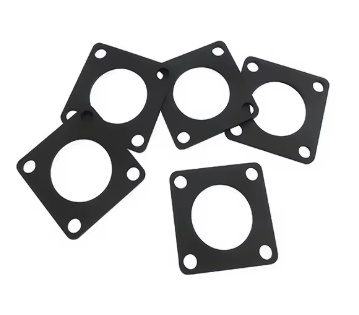
Wayne Rubber manufactures custom rubber washers for fastener sealing, component spacing, load distribution, and vibration isolation across industrial, plumbing, HVAC, automotive, electrical, and food processing applications. Available in flat, beveled, and shouldered profiles, compression molded to precise dimensional tolerances in EPDM, nitrile, neoprene, silicone, FKM, and natural rubber.
Rubber washers are simple in geometry but the material choice, thickness, and durometer directly determine whether the washer seals long-term or takes a permanent set and leaks. The sections below cover the three distinct functions washers serve and what each one requires from the specification.
Three Functions, Three Different Specifications
Rubber washers are specified for three distinct engineering purposes. Each one places different demands on compound, durometer, and thickness. Knowing which function the washer must perform is the starting point for every other decision.
The washer seals the interface between a fastener head or nut and the mating surface, preventing fluid, gas, or dust ingress through the fastened joint. The rubber must be soft enough to conform to both the fastener and the mating surface under bolt load, creating a continuous sealing contact. Durometer typically 50 to 65 Shore A. Material selected for the specific fluid or environment being sealed. Long-term sealing retention depends on the compound’s compression set resistance; a washer that takes a permanent set loses sealing force and eventually leaks.
The washer creates a precise gap between two components or distributes the compressive load from a fastener across a wider area to prevent surface damage or pull-through in soft materials. In this role dimensional accuracy (thickness tolerance in particular) is the primary requirement. Durometer can be higher (65 to 80 Shore A) since conformance to surface irregularities is less critical than maintaining a consistent stack height under load. Compression set resistance matters because the spacer dimension must remain consistent throughout the service life.
The washer decouples a fastened component from the structure it is mounted to, reducing vibration transmission through the fastener joint. The washer acts as a compliant element in the load path, absorbing and attenuating vibration energy before it reaches the structure. Softer compounds (40 to 55 Shore A) provide greater vibration isolation at low frequencies. The washer must be stiff enough to maintain fastener preload while still providing meaningful compliance. Bonded metal-rubber washer assemblies extend this capability to applications where through-bolt clamping force would otherwise crush a plain rubber washer.
Molded vs. Die-Cut Washers
Rubber washers can be produced by compression molding or by die-cutting from rubber sheet stock. The right method depends on production volume, required tolerances, thickness, and whether the washer has any non-flat features. Wayne Rubber produces washers by compression molding; die-cut washers are better suited to distributors with sheet inventories.
- Tighter dimensional tolerances on ID, OD, and thickness than die-cut
- Flash-free sealing faces achievable with correct tool design
- Non-flat profiles: beveled faces, shoulder features, integrated sealing lips
- Consistent compound properties throughout the cross-section
- Required for thick washers where die-cutting produces edge tearing
- Economical at moderate-to-high volumes; tooling investment amortizes quickly
- Compound can be fully specified to application requirements
- No tooling cost for standard OD/ID combinations
- Lower minimum order quantities for simple flat profiles
- Wider OD/ID tolerances than molded parts
- Limited to flat profile only; no non-flat features possible
- Compound limited to available sheet stock grades
- Edge cut quality varies; burrs and torn edges possible on thin sections
- Best for low-volume, non-critical applications where tolerances are wide
Dimensions and Properties to Specify
| Dimension / Property | Notes |
|---|---|
| Inner Diameter (ID) | Must clear the bolt or fastener shank with enough clearance for installation without excessive gap at the sealing face. For sealing washers, keep the ID clearance as small as practical; a large gap between the ID and the fastener shank is a potential leak path at the underhead contact zone. Specify ID tolerance explicitly; die-cut washers have significantly wider ID tolerances than molded. |
| Outer Diameter (OD) | Must be larger than the fastener head or nut across flats so the washer extends beyond the fastener contact zone on all sides. For load distribution washers, OD determines the bearing area and therefore the stress applied to the mating surface per unit bolt load. Larger OD reduces surface stress and reduces the risk of pull-through in soft or thin mating materials. |
| Thickness | The most important dimension for both sealing performance and spacing accuracy. For sealing washers, thickness must be enough to provide sufficient compression travel under bolt load without bottoming out the fastener head. For spacer washers, thickness must be held to a tight tolerance to maintain the required stack height. Always specify a tolerance; “nominal” thickness alone is not sufficient for a sealing or spacing application. |
| Durometer (Shore A) | Specify the nominal Shore A hardness and a tolerance of ±5 Shore A. Do not leave durometer unspecified; the manufacturer will select a general-purpose compound that may not have the sealing compliance or creep resistance the application requires. Softer grades seal better on rough surfaces under lower bolt loads; harder grades resist creep better under sustained static load. |
| Compound | Specify the elastomer family and any compliance requirements (FDA, NSF, MIL-spec, RoHS). If the fluid or environment is known, use the Chemical Resistance Guide to confirm compatibility before specifying. If the compound is unknown, describe the fluid, temperature, and exposure so Wayne Rubber can recommend the correct elastomer. |
| Surface Condition | For sealing washers, specify “sealing faces free of flash” on both flat faces that contact the fastener and mating surface. Flash on a sealing face creates a localized high-stress contact ridge that opens a leak path on either side of it. For spacer washers, flash on the bearing face affects measured stack height. |
| Compression Set Requirement | For sealing washers in sustained bolt-load applications, specify maximum allowable compression set per ASTM D395 Method B at the relevant service temperature. This defines the compound’s long-term sealing retention requirement separately from the durometer specification, since two compounds of the same durometer can have very different compression set values depending on their cure system. |
Washer Materials
The standard sealing washer compound for water, plumbing, HVAC, and outdoor fastener applications. Excellent resistance to hot water, steam, UV, and ozone. FDA grades available for potable water and food-contact applications. Not suitable for petroleum fluid contact.
View EPDM data →Versatile general-purpose compound with good ozone, UV, and moderate oil resistance. The standard washer compound for outdoor mechanical and electrical enclosure fasteners. Good compression set resistance at medium durometers. Widely stocked and cost-effective for most industrial sealing washer applications.
View CR data →Oil and fuel resistant. Required for fastener sealing washers in fuel systems, hydraulic equipment, and industrial machinery with oil-wetted fastener joints. Standard for automotive and marine engine compartment fasteners where petroleum fluid splash is expected.
View NBR data →Wide temperature range for high-temperature sealing washer applications in ovens, furnaces, engine-adjacent fasteners, and food processing equipment. FDA and USP Class VI grades for food, pharmaceutical, and medical device fastener sealing. Lower compression resistance than neoprene at sustained load; specify peroxide-cured grades for best set resistance.
View silicone data →Chemical and high-temperature resistant sealing washers for aggressive chemical plant fasteners, fuel system connections with aromatic fuel content, and continuous high-temperature service above 250°F where EPDM, neoprene, and silicone are insufficient.
View FKM data →Highest resilience and fatigue resistance. Used for vibration-isolating washer applications in high-cycle dynamic assemblies where the washer undergoes repeated compression cycling. Not suitable for petroleum contact or outdoor UV/ozone exposure.
View NR data →Rubber Washer Applications
Washer Manufacturing Capabilities
- Compression Molding: flat, beveled, and shouldered profiles to precise dimensional tolerances
- Flash-Free Sealing Faces: available with correct tool design for critical sealing applications
- Full Compound Range: EPDM, nitrile, neoprene, silicone, FKM, natural rubber, and HNBR
- FDA / NSF Grades: food-contact and potable water compliant compounds in silicone and EPDM
- Durometer Range: 40 to 90 Shore A across all listed elastomer families
- Bonded Metal-Rubber Washers: rubber sealing element bonded to steel or stainless washer body for roofing, structural, and high-pressure fastener sealing
- Compression Set Testing: ASTM D395 Method B testing available for sealing washer programs requiring documented set resistance
- Prototype to Production: development quantities through high-volume production runs
- RMA A2 Tolerances: baseline dimensional tolerances per RMA A2 precision standard
- Custom Profiles: non-standard OD/ID combinations, tapered faces, and integrated sealing lips available
Request a Quote for Custom Rubber Washers
Provide the washer function (sealing, spacing, or vibration isolation), ID, OD, thickness, bolt load, compound, and the fluid or environment to be sealed. Wayne Rubber will confirm the specification and quote.