
Nitrile Gaskets
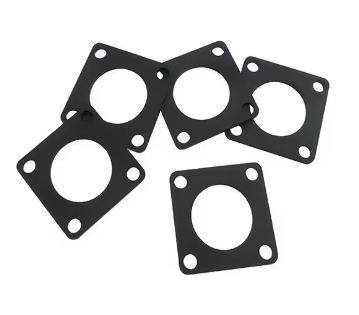
Nitrile rubber (NBR, also called Buna-N) is the default gasket material for any application where petroleum oil, hydraulic fluid, fuel, or lubricant contact is present. No other standard elastomer at comparable cost offers NBR’s combination of oil resistance, mechanical strength, and compression set performance. But not all nitrile gaskets are the same: commercial-grade sheet is a 70/30 NBR/SBR blend that costs less and performs adequately in benign conditions; premium 100% NBR has significantly better oil resistance and physical properties; specialty grades cover biodiesel fuels, transformer oil, FDA food-contact, MIL-spec, and hot-oil service above 250°F where HNBR is required. Specifying the right grade for the application determines whether the gasket lasts one year or ten.
Wayne Rubber manufactures custom nitrile gaskets in Wixom, Michigan by compression molding, transfer molding, injection molding, and die-cutting from sheet. Standard and custom profiles in all durometers and thicknesses, from prototype through production volume.
Why Nitrile is the Standard Gasket Material for Oil and Fuel Service
Nitrile rubber’s oil resistance comes from its acrylonitrile (ACN) content, a polar monomer that resists swelling in nonpolar petroleum fluids. Standard gasket compounds run approximately 33% ACN, which balances oil resistance against low-temperature flexibility. Higher ACN content (40-50%) improves resistance to aromatic fuels and aggressive oils at the cost of cold flexibility; lower ACN content (18-28%) extends low-temperature service to -65°F for cold-climate hydraulic and fuel systems.
For static gasket applications, NBR’s compression set resistance is a critical property. A gasket under sustained bolt load must maintain sealing contact force over years of service. NBR’s compression set performance at 70°F is excellent; it remains acceptable at 200°F for most hydraulic and oil service. Above 250°F, NBR’s polysulfidic crosslinks begin to degrade and compression set rises steeply. For hot oil service above 250°F — high-output diesel engines, process equipment with hot hydraulic circuits, refinery flanges — HNBR is the correct specification, not a higher grade of standard NBR.
NBR gaskets resist a broad range of fluids: mineral oils, petroleum hydraulic fluids, most fuels, animal and vegetable fats, water, and dilute acids and bases. Its primary limitations are ozone and UV degradation in outdoor exposure — NBR gaskets in outdoor equipment enclosures will crack within months of direct sunlight exposure without a protective jacket — and poor resistance to polar solvents (ketones, esters, acetone), concentrated acids, and steam.
The grade question is frequently overlooked. Most gasket distributors offer “commercial grade nitrile” as their standard product. Commercial grade is a 70% NBR / 30% SBR blend — it reduces material cost but also reduces oil resistance and physical properties compared to 100% NBR premium grade. For demanding hydraulic and fuel system gaskets in industrial and automotive applications, premium 100% NBR is the correct specification. Wayne Rubber supplies both grades and can recommend the right one based on the specific fluid contact and service conditions.
Nitrile Gasket Grades from Wayne Rubber
The standard catalog grade available from most distributors. A blend of 70% nitrile rubber and 30% styrene-butadiene rubber, providing moderate oil resistance at reduced cost. Durometer 60 Shore A standard. Temperature range -30°F to +200°F. Best for: general industrial gasketing, machinery covers, non-critical hydraulic equipment panels, and applications where oil splash contact is incidental rather than sustained. Not suitable for: prolonged immersion in petroleum fluids, fuel system flanges, or any application requiring resistance to concentrated oils and solvents where premium grade performance is needed. Most gasket distributor “standard NBR” is this blend.
100% nitrile rubber with no SBR blending, providing full oil and fuel resistance per ASTM D2000 specifications. Available 40-90 Shore A. Temperature range -40°F to +250°F. Best for: hydraulic system flanges and cover gaskets, fuel system pipe flanges and inspection covers, oil-wetted industrial equipment with prolonged immersion, automotive transmission and engine cover gaskets, and any application requiring confirmed compliance with ASTM D2000 line callouts. Premium grade is required for applications specifying NBR by compound designation rather than just by generic “nitrile” descriptor.
NBR compound manufactured from ingredients listed under FDA 21 CFR 177.2600 for repeated food-contact applications. Available in white (standard for food processing) and black. Durometer 60 Shore A standard. Temperature range -40°F to +212°F. Best for: food processing and beverage equipment gaskets where incidental food contact is possible, dairy equipment cover gaskets, USDA meat and poultry processing facility equipment (meets USDA approval where applicable). Food-grade NBR gaskets are the oil-resistant option for food processing environments where standard FDA silicone is cost-prohibitive for large-format gaskets.
Biodiesel/Alternative Fuel Grade: Formulated for B20 and B100 biodiesel and E85 ethanol fuel blends, which attack standard NBR compounds through ester-phase attack on the polymer. Required for fuel system gaskets on equipment running modern fuel blends. Transformer Oil Grade: Meets GE A12C11E7 and ASTM D2000 5BG specifications for electrical transformer fluid contact. The low electrostatic charging tendency is a critical property for transformer flange gaskets. MIL-Spec Grade: Certified to MIL-R-6855 Class 1 with full material traceability documentation for defense and aerospace program gaskets. Available with first article inspection reports.
Molded Nitrile Gaskets vs. Die-Cut Sheet: When Each Is Correct
Die-cutting from sheet stock is the standard method for flat gaskets of simple profile — a flat ring, a rectangular frame, or a simple flange profile. It is fast, requires no tooling for the gasket profile itself (only a cutting die or digital knife path), and is economical for low-to-medium volumes. Nearly all gasket distributors and fabricators work exclusively by die-cutting from roll stock. Die-cut nitrile gaskets are correct for most standard flange, cover, and panel gasket applications.
The limits of die-cutting: wall thickness below about 3/32″ becomes difficult to handle and install without tearing; complex profiles with internal features, multiple material zones, or three-dimensional geometry cannot be produced from flat sheet; and dimensional consistency across large production lots is limited by sheet thickness variation (typically ±10-15% on commercial sheet stock).
Compression or injection molded nitrile gaskets are required when the gasket profile cannot be produced by cutting from flat sheet. Molded gaskets with sealing beads, lips, integrated o-ring profiles, variable cross-section, or non-flat geometry require a mold cavity that defines the full three-dimensional profile of the part. Molded gaskets also offer tighter dimensional tolerances than die-cut parts — typically RMA Class A2 precision vs. ±0.015″ for die-cutting — which matters when the gasket must reliably locate within a close-tolerance housing.
For high-volume programs where consistent lot-to-lot dimensional repeatability is required, molded nitrile gaskets amortize tooling cost rapidly and provide better quality control than die-cutting from sheet whose thickness varies batch to batch. Wayne Rubber can quote both methods and recommend the most cost-effective approach for the specific profile, volume, and tolerance requirement.
Nitrile Gasket Applications by Industry
- Hydraulic manifold cover gaskets and inspection plates
- Pump and motor housing flange gaskets
- Valve body and bonnet gaskets in petroleum systems
- Filter housing cover gaskets
- Cylinder end cap and port cover gaskets
- Accumulator housing seal gaskets
- Engine oil pan gaskets (commercial to premium grade)
- Transmission case and cover gaskets
- Power steering reservoir cover gaskets
- Differential and axle housing cover gaskets
- Fuel system flange and inspection gaskets
- Compressor and pump cover gaskets
- Gearbox and lubrication system cover gaskets
- Machine tool coolant system gaskets (oil-based coolant)
- Compressor valve plate and cover gaskets
- Hydraulic press and cylinder cover gaskets
- Industrial pump flange gaskets in oil service
- Conveyor lubrication system housing gaskets
- Fuel storage tank inspection cover gaskets
- Petroleum pipeline flange gaskets
- Fuel dispenser housing and cover gaskets
- Above-ground storage tank manway gaskets
- Fuel system pump and filter housing gaskets
- Biodiesel system gaskets (biodiesel-grade NBR)
- Cooking oil and fat system equipment gaskets
- Meat and poultry processing equipment gaskets
- Dairy equipment cover gaskets (FDA white NBR)
- Vegetable oil processing flange gaskets
- Food-grade lubricant system inspection gaskets
- Fryer and cooking equipment housing gaskets
- MIL-R-6855 Class 1 certified gaskets for military hydraulics
- Aircraft ground support equipment fuel system gaskets
- Military vehicle hydraulic and lubrication system gaskets
- Defense electronics housing gaskets for oil-adjacent locations
- Naval vessel hydraulic system inspection cover gaskets
- Ordnance handling equipment lubrication system gaskets
Nitrile vs. Other Gasket Materials
| Condition | Specify | Reason |
|---|---|---|
| Petroleum oil, hydraulic fluid, or fuel contact below 250°F | NBR (premium grade) | Best combination of oil resistance, mechanical properties, and cost for standard oil-service gaskets. Use premium 100% NBR, not commercial blend, for sustained immersion. |
| Hot oil above 250°F (engine bay, refinery, industrial process) | HNBR | Standard NBR crosslinks degrade above 250°F, causing hardening, cracking, and compression set failure. HNBR maintains oil resistance to 300°F with stable compression set. |
| Water, steam, coolant, or outdoor UV exposure without oil contact | EPDM | NBR degrades rapidly in ozone, UV, and steam. EPDM is the correct material for all water, steam, and outdoor weather applications where no petroleum fluid contact is present. |
| Aggressive chemicals, solvents, or temperatures above 300°F | FKM | NBR is attacked by ketones, esters, and concentrated acids. FKM provides broad chemical resistance and high-temperature stability when NBR’s limits are exceeded. |
| General industrial use with mixed oil and outdoor exposure | Neoprene | Neoprene provides moderate oil resistance alongside UV and ozone resistance, making it the balanced choice when the environment cannot be characterized as exclusively oil-service or exclusively outdoor. |
| Food contact, pharmaceutical, or high-temperature industrial | Silicone | FDA-grade silicone covers a wider temperature range than NBR and has lower extractables for food and pharmaceutical compliance. Use FDA NBR where silicone’s higher cost is a constraint and temperature is below 212°F. |
Also from Wayne Rubber
Request Custom Nitrile Gaskets from Wayne Rubber
Provide the gasket profile (drawing, sample, or dimensions), the fluid contact and operating temperature, the grade required (commercial, premium, FDA, or specialty), and the quantity. Wayne Rubber will confirm the compound, recommend the manufacturing method, and quote tooling and piece cost.